
Portfolio decisions that support business growth
Start by examining how each property supports your business priorities, using evidence rather than assumptions. Optimising commercial real estate for business growth means reviewing space use alongside operational needs, workforce plans and each location’s role. This gives you a clearer basis for de...



Start by examining how each property supports your business priorities, using evidence rather than assumptions. Optimising commercial real estate for business growth means reviewing space use alongside operational needs, workforce plans and each location’s role. This gives you a clearer basis for deciding what to retain, adapt or change.
Hybrid work and expansion can make an existing portfolio a poor fit, but reducing space is not automatically the answer. A sound strategy balances cost, workplace experience and room to scale. Assess your portfolio, adapt spaces to changing work patterns and align property decisions with business goals as operations grow.
Key Takeaways
• Use space-use patterns and workforce needs to decide whether to adapt, share or reduce office space.
• Assess total occupancy costs and operational data together to identify where your portfolio can support more efficient growth.
• Review each location against business priorities, using local property and operational measures to guide decisions.
• Build flexibility into portfolio planning so spaces can respond as team needs and operations change.
1. How do evolving work models like hybrid work impact portfolio strategy?
Businesses can support productivity and revenue by matching each space to how people work, shop or move goods. Compare actual use with operational needs, then adapt layouts, locations or lease commitments where the evidence points to a better fit.
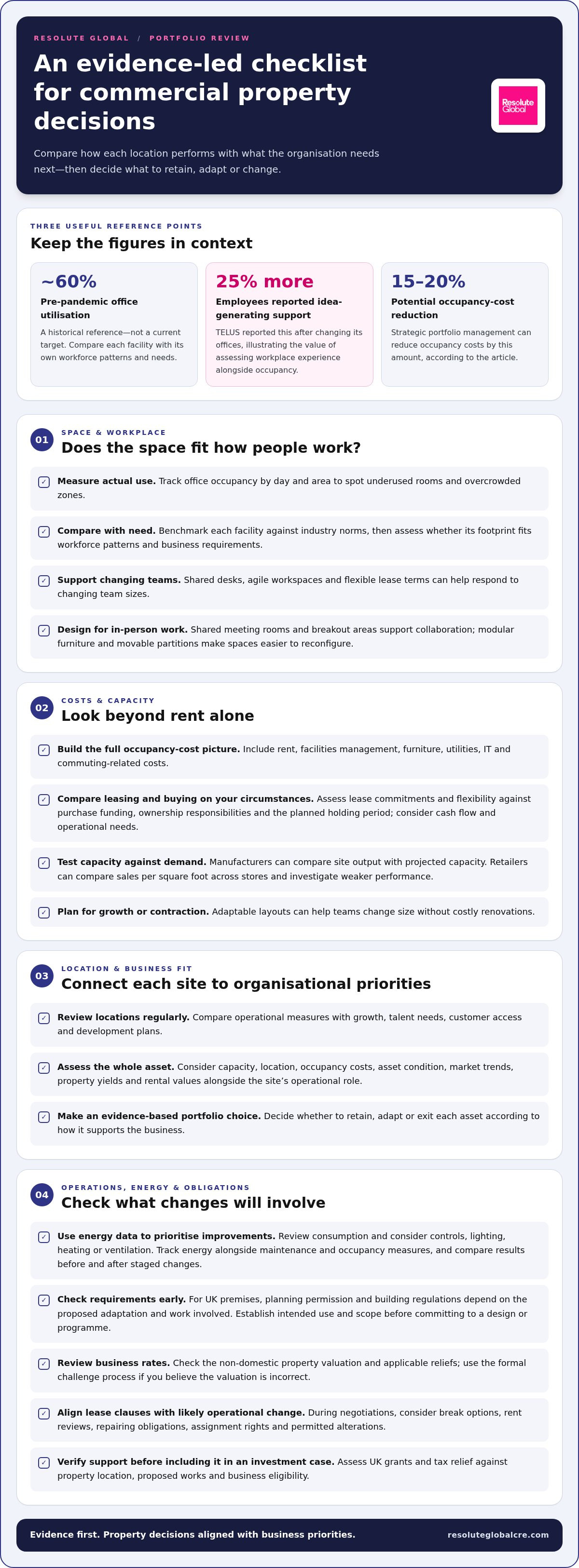
For offices, track occupancy by day and area to identify underused rooms and overcrowded zones. Before the pandemic, office space utilisation was about 60%, a useful historical reference rather than a current target. Benchmark each facility against industry norms, then assess whether its footprint still fits workforce patterns and business needs. Shared desks, agile workspaces and flexible lease terms can help organisations respond to changing team sizes without relying on a fixed layout.
Hybrid teams need spaces designed for the work they come in to do. Shared meeting rooms and breakout areas give colleagues places to collaborate in person, whilst modular furniture and movable partitions make rooms easier to reconfigure. TELUS reported that after changing its offices, 25% more employees felt their workplace helped them generate new ideas. That example shows why evaluating workplace experience alongside occupancy can reveal opportunities beyond simply reducing space.
Apply the same evidence-led approach across property types. Retailers can compare sales per square foot across stores to identify stronger locations and investigate weaker performance. Manufacturers can compare site output with projected capacity to assess production and distribution efficiency. Optimising commercial real estate for business growth means placing space where it supports operations and the organisation’s character, not simply cutting area.
2. Scaling operations and expanding property portfolios
As operations grow, assess each asset against capacity, location and total occupancy costs. Include rent, facilities management, furniture, utilities, IT and commuting-related costs; rent alone can obscure the real cost of office space. Strategic portfolio management can reduce occupancy costs by 15% to 20%, while adaptable layouts help teams expand or contract without costly renovations.
Leasing and buying have no universal cost winner. Compare lease commitments and flexibility with purchase funding, ownership responsibilities and the planned holding period, then assess each option against cash flow and operational needs. Consider property yields and rental values alongside occupancy costs, asset condition, market trends and each site’s role. This provides a fuller basis for comparing properties than headline rent or yield alone.
To improve energy efficiency, review energy-use data and identify opportunities to adapt controls, lighting, heating or ventilation. Track consumption alongside maintenance and occupancy measures, then prioritise work that supports lower operating demand and a better workplace experience. Make changes in stages and compare operational measures before and after each one.
UK grants and tax relief for property improvements should be assessed against the property's location, proposed works and business eligibility. Build this review into project planning, and include only support the organisation qualifies for in its investment case. For expansion across markets, a global real estate advisory network can help inform portfolio decisions across locations.
3. Aligning commercial real estate with business strategy
Corporate property decisions work best when they follow business priorities rather than a fixed portfolio template. Set a regular review schedule and compare each location’s operational measures with objectives such as growth, talent needs, customer access and development plans. Turn those findings into decisions to retain, adapt or exit assets according to their role.
Location strategy should reflect how each operation creates value. Manufacturers can compare site output with projected capacity to identify production or distribution constraints. Retailers can examine sales per square foot across stores and investigate locations that lag. These measures connect property choices to output and revenue instead of relying on market trends alone.
For UK premises, planning permission and building regulations depend on the proposed adaptation and work involved. Establish the intended use and scope early, then identify relevant requirements before committing to a design or programme.
Business rates are taxes on non-domestic property. Review the property valuation and applicable reliefs, then use the formal challenge process if you believe the valuation is incorrect.
Commercial leases can leave occupiers with inflexible commitments or unexpected liabilities. During negotiations, focus on break options, rent reviews, repairing obligations, assignment rights and permitted alterations. Align each clause with likely changes to your operations.
Make property a strategic enabler by linking location-level evidence to corporate goals. Align your property strategy with business priorities through an independent, occupier-focused review.
Regular portfolio reviews can test opportunities against organisational priorities. Location-specific property and operational measures then show whether the strategy advances broader goals.
Resolute Global: Occupier-focused CRE Guidance
Resolute Global provides occupier-focused Corporate Real Estate guidance to help businesses align property decisions with operational priorities, growth plans and workplace needs. Turn to this support when reviewing a portfolio, assessing expansion opportunities or deciding how property can better serve your organisation.
For decisions spanning markets, Resolute Global’s global advisory network brings a broader perspective to location and portfolio planning. Its occupier-only advice keeps the focus on your interests, helping you evaluate options clearly and make decisions grounded in your objectives.
Explore how Resolute Global can support your property strategy. Contact Resolute Global or visit resoluteglobalcre.com.
Make your next property decision count
Treat your next portfolio decision as an opportunity to make room for your organisation’s ambitions. Optimising commercial real estate for business growth is not a one-off reset; it is a disciplined way to keep property choices connected to changing priorities. Set a review point, identify the decision that matters most now, and agree what evidence will show whether the direction is working. This gives leaders a practical basis for acting confidently while leaving room to adjust as plans evolve.
The right support can bring sharper perspective to complex portfolio choices and help turn competing priorities into a clear course of action. If your organisation is ready to take the next step, discuss your portfolio with Resolute Global. A considered decision today can make future growth easier to pursue.
Frequently Asked Questions
What is the first step in optimising a real estate portfolio?
Start by defining the business decisions your portfolio needs to support. If a company plans to add a product line, for example, identify which sites have suitable capacity, access and infrastructure. Gather comparable information for each property so leaders can distinguish a genuine operational constraint from an assumption based on past use.
How do evolving work models like hybrid work impact portfolio strategy?
Hybrid work makes attendance patterns less predictable, so portfolio plans need to account for when different teams use spaces. Map shared work needs, such as confidential meetings or team training, against on-site days. This helps businesses decide which facilities need dedicated areas and where adaptable arrangements can accommodate changing schedules.
What are the primary benefits of effective portfolio optimisation?
Effective optimisation directs property resources towards the business activities that matter most. It can support more efficient use of capital, better align workplaces with team needs and reveal when a location no longer serves its intended purpose. A stronger portfolio also gives decision-makers a clearer basis for responding to operational change.
What role does lease expiration management play in portfolio optimisation?
Managing lease expirations gives businesses time to make informed choices before contractual deadlines limit their options. Keep a central record of expiry dates, notice requirements, rent review dates and break clauses. Reviewing them together helps identify upcoming decisions early, coordinate internal approvals and prepare a coherent negotiation or relocation plan for each property.
Why does commercial space optimisation matter?
Commercial space optimisation matters because property should enable work, not constrain it. A layout that obstructs deliveries, separates teams that need to collaborate or lacks suitable facilities for essential functions can undermine daily operations. Matching space to actual workflows helps businesses support staff, serve customers and make better use of their physical assets.
Proudly Untraditional
We’re proudly untraditional in the way we think, operate, and deliver value in the Corporate Real Estate sector.
Whether you’re a client seeking a new experience or an independent real estate adviser please get in touch to learn more.
More from the field
Keep reading for more sharp analysis on global corporate real estate