
Strategic Tenant Representation: The Conflict-Free Guide
When legacy property brokerages sit on both sides of the table, it's your balance sheet that pays the price. You probably already suspect that traditional advisory relationships tilt towards institutional landlords, leaving occupiers to shoulder inflated terms and hidden leasehold costs. Genuine str...


When legacy property brokerages sit on both sides of the table, it's your balance sheet that pays the price. You probably already suspect that traditional advisory relationships tilt towards institutional landlords, leaving occupiers to shoulder inflated terms and hidden leasehold costs. Genuine strategic tenant representation dismantles this compromise entirely. By enforcing complete structural independence, dedicated occupier advocacy ensures your operational agility, financial targets, and corporate objectives drive every negotiation. True alignment shouldn't be an afterthought.
Discover how strategic tenant representation protects occupier interests, eliminates dual agency conflicts, and optimises corporate portfolios without the friction of rigid advisory firms. Below, we examine the mechanics of independent representation, the shift towards agile Corporate Real Estate leadership, and actionable frameworks to secure decisive commercial advantage across your property footprint.
Key Takeaways
• Understand why traditional dual agency structures inherently compromise tenant outcomes by prioritising institutional landlord revenue over occupier balance sheets.
• Discover how strategic tenant representation aligns leasehold obligations directly with broader corporate financial performance, workplace agility, and operational milestones.
• Identify hidden liabilities within existing portfolios through rigorous benchmarking of reinstatement clauses, break options, and escalation formulas.
• Learn how to access elite Corporate Real Estate leadership rapidly via agile Fractional Executives without bearing permanent full-time C-suite overheads.
What Is Strategic Tenant Representation in Corporate Real Estate?
While physical assets sit within broader commercial real estate markets, Corporate Real Estate represents something distinct: the direct integration of operational property with corporate balance sheets, workforce productivity, and capital allocation. Strategic tenant representation delivers exclusive, fiduciary advocacy exclusively for occupiers navigating these operational commitments. Rather than merely chasing square metres, dedicated representation aligns property footprints directly with corporate agility, financial forecasts, and long-term enterprise value.
The Hidden Operational Costs of Dual Agency Brokerage
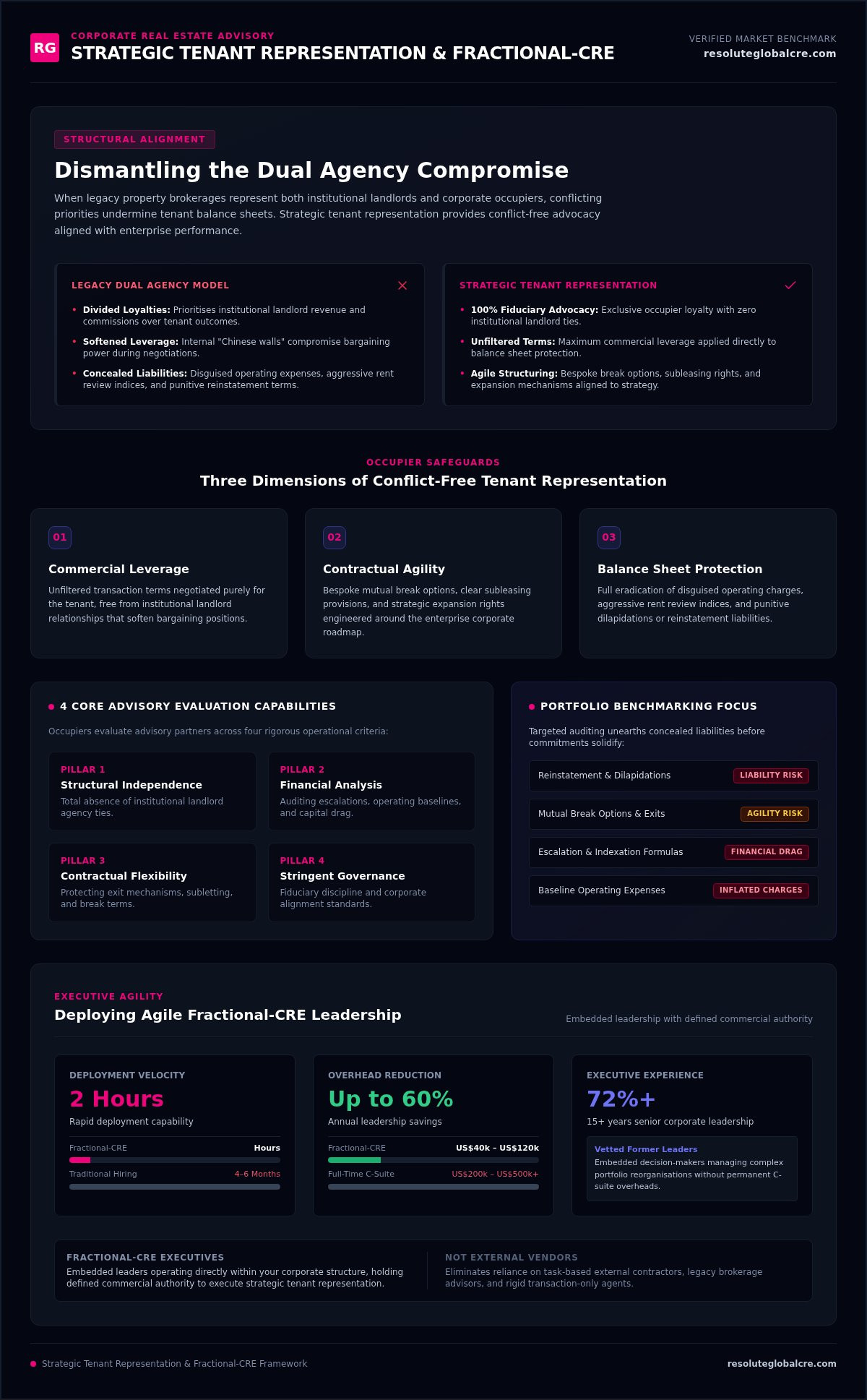
Dual agency brokerages inevitably compromise tenant leverage. When legacy advisory houses represent institutional landlords across major portfolios whilst simultaneously negotiating on behalf of occupiers, structural friction is unavoidable. Corporate "Chinese walls" rarely insulate tenants when significant landlord commissions are at stake.
Independent strategic tenant representation eliminates these divided loyalties entirely, safeguarding your commercial position across three vital dimensions:
Commercial Leverage
Unfiltered transaction terms negotiated without institutional landlord relationships softening your bargaining position.
Contractual Agility
Bespoke break options, subleasing provisions, and expansion rights engineered around your corporate roadmap.
Balance Sheet Protection
Full eradication of disguised operating expenses, aggressive rent review indices, and punitive reinstatement liabilities.
Evaluating Strategic Tenant Representation: Core Pillars for Occupiers
Selecting an advisory partner shouldn't mean inheriting another rigid transactional vendor. To truly protect an organisation's capital, modern occupiers evaluate potential partners against four core capabilities: absolute structural independence, rigorous financial analysis, contractual flexibility, and stringent governance. Advanced portfolio benchmarking conducted through this lens unearths concealed liabilities before they solidify into long-term balance sheet drags. It identifies premature lease exit vulnerabilities, inflated baseline operating charges, and capital misallocations that legacy agents routinely miss.
Aligning Corporate Property Strategy with Enterprise Financial Objectives
Property commitments must never operate within an administrative silo. Executives must actively connect real estate decisions to corporate strategy, treating every square metre as an engine for enterprise performance rather than an inflexible sunk cost. That means auditing prospective dilapidations liabilities, negotiating mutual break terms, and formalising subletting rights long before commencing formal market transactions.
Independent strategic tenant representation ensures your occupational terms remain resilient when market conditions shift. Before committing your capital to binding multi-year agreements, explore Resolute Global to benchmark your existing lease profile against conflict-free market standards.
Deploying Conflict-Free Representation Through Agile Fractional-CRE Leadership
Traditional executive recruitment cycles drag on for four to six months. In fast-moving markets, that inertia stalls vital portfolio reorganisations and exposes organisations to costly lease rollovers. Through the world's first Fractional-CRE platform, occupiers gain immediate access to vetted former corporate property leaders. Engagements can be completed in hours; in fact, rapid deployments have been completed in two hours. Crucially, these professionals aren't external consultants or task-based contractors. Fractional-CRE Executives serve as embedded leaders with defined commercial authority, executing strategic tenant representation directly from within your leadership structure.
Bridging the Executive Resource Gap with Fractional Real Estate Leadership
Securing permanent property leadership introduces substantial financial friction, with full-time C-suite hires demanding US$200k to US$500k+ annually. Agile Fractional Executives deliver identical high-calibre guidance for US$40k to US$120k annually, reducing leadership overheads by up to 60%. Capability remains uncompromised: over 72% of curated Fractional-CRE Executives bring 15+ years of senior corporate leadership experience to complex transactions.
Occupiers don't have to tolerate conflicted brokerage advice or excessive corporate headcount. To integrate senior Corporate Real Estate leadership equipped to deliver uncompromising strategic tenant representation across your national portfolio, contact Resolute Global today.
Securing Pure Occupier Advocacy for Your Portfolio
Achieving operational resilience requires shedding outdated brokerage practices. By demanding complete structural independence, 100% dedicated to occupiers with zero landlord representation conflicts, organisations insulate balance sheets and negotiate from genuine strength. Modern strategic tenant representation bridges the senior talent gap without traditional overheads. Through embedded Fractional Executives, businesses engage elite leaders boasting 15+ years of experience in hours, with onboarding completed in two hours. Crucially, this agile structure delivers up to 60% savings compared to permanent C-suite hires (US$40k–US$120k versus US$200k–US$500k+ annually).
Lease commitments shouldn't drag down enterprise performance; they should actively propel it. Take decisive control of your property strategy today. Access Conflict-Free Corporate Real Estate Leadership at Resolute Global to secure enduring financial and operational advantage.
Frequently Asked Questions
What is the difference between tenant representation and dual agency brokerage?
Dual agency brokerages represent both landlords and occupiers within the same market, creating unavoidable conflicts of interest. In contrast, pure tenant representation provides exclusive, fiduciary advocacy solely for the occupier. This structural independence guarantees that lease negotiations, rent reviews, and incentive packages are never softened by institutional landlord relationships or secondary agency commissions.
Can strategic tenant representation reduce ongoing Corporate Real Estate costs?
Yes. Dedicated strategic tenant representation directly curbs occupational expenses by auditing baseline operating charges, eliminating aggressive indexation formulas, and capping service charges. Beyond headline rent reductions, occupier advocates secure balanced reinstatement terms and flexible break options, protecting your balance sheet from punitive dilapidations claims and surplus space liabilities throughout the lease lifecycle.
How quickly can an organisation engage a Fractional-CRE Executive for negotiations?
Engagements can be completed in hours, with placements completed in two hours when critical transaction windows demand immediate action. Unlike traditional C-suite recruitment that takes 4 to 6 months, organisations gain rapid access to former corporate directors. These professionals don't operate as arm's-length consultants; they integrate as embedded leaders with defined commercial authority.
Why is Corporate Real Estate distinguished from commercial real estate in strategy?
Commercial real estate treats physical properties as investment assets, capital instruments, or landlord revenue streams. Corporate Real Estate, conversely, focuses on the operational spaces occupied by a business to conduct its core operations. It aligns facility commitments directly with enterprise balance sheets, employee performance, and long-term corporate agility rather than third-party yield.
Proudly Untraditional
We’re proudly untraditional in the way we think, operate, and deliver value in the Corporate Real Estate sector.
Whether you’re a client seeking a new experience or an independent real estate adviser please get in touch to learn more.
More from the field
Keep reading for more sharp analysis on global corporate real estate


