
How to Manage a Commercial Property Portfolio as a Tenant
A property portfolio should serve the business, not dictate how it works. A corporate real estate strategy for tenants connects workplace choices to business priorities: review each site’s purpose, costs, space use and lease commitments, then decide what to retain, adapt or exit. Review the strategy...



A property portfolio should serve the business, not dictate how it works. A corporate real estate strategy for tenants connects workplace choices to business priorities: review each site’s purpose, costs, space use and lease commitments, then decide what to retain, adapt or exit. Review the strategy when lease expirations approach within 18 to 24 months, so decisions aren’t left until renewal pressure takes over.
It’s easy to treat property as a fixed overhead or facilities issue. But the right locations and lease terms can support how your people work and help the business adapt to change.
This guide explains corporate real estate strategy for tenants and sets out practical steps for managing a UK property portfolio. Learn how to assess space, plan for lease events and align property decisions with operational needs and longer-term goals.
Key Takeaways
• Map lease expiries and start reviewing upcoming decisions early, so renewal or renegotiation plans are shaped by business needs rather than deadlines.
• Clarify whether the company or an individual employee is named on the tenancy agreement, and how rent and accommodation responsibilities are arranged.
• Assess each property against how your teams work, where the business needs to operate and what flexibility future plans may require.
• Use independent, occupier-focused advice when portfolio choices span markets or require a conflict-free perspective.
What are the best practices for managing a commercial real estate portfolio?
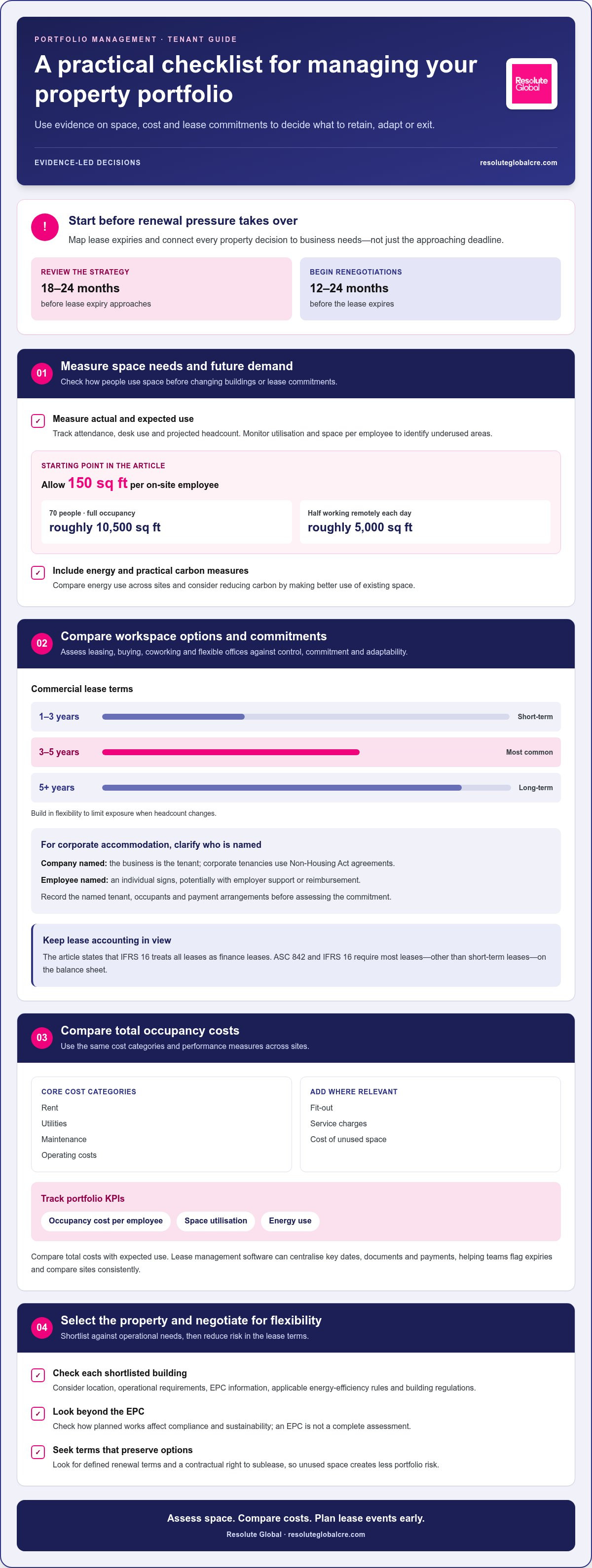
Manage the portfolio through evidence-led decisions: assess space, compare options, understand costs and negotiate flexibility.
•
Assess space needs and future headcount
Measure attendance, desk use and projected headcount before changing buildings or lease commitments. Use 150 square feet per on-site employee as a starting point: a 70-person team would need roughly 10,500 square feet at full occupancy, or 5,000 square feet if half work remotely each day. Track utilisation and space per employee to identify underused areas. Compare energy use across sites and consider practical carbon-reduction measures, such as improving how existing space is used.
•
Compare leasing and workspace options
Compare leasing, buying, coworking and flexible office space against control, commitment and capacity to adapt. Short-term commercial leases are one to three years; three to five years is the most common term, while long-term leases are five or more years. Build flexibility into the choice to limit exposure when headcount changes. For corporate accommodation, distinguish a company named on a tenancy agreement from an employee named individually; corporate tenancies use Non-Housing Act agreements. For accounting, IFRS 16 treats all leases as finance leases, while ASC 842 and IFRS 16 require most leases, other than short-term leases, on the balance sheet.
•
Compare total occupancy costs
Compare each building using consistent cost categories: rent, utilities, maintenance and operating costs. Where relevant, include fit-out, service charges and the cost of unused space, then compare total costs with expected use. Track occupancy cost per employee, space utilisation and energy use as portfolio KPIs. Lease management software can centralise key dates, documents and payments, helping teams flag upcoming expiries and compare sites consistently.
•
Select a property and negotiate lease terms
Shortlist buildings against location, operational requirements, EPC information and applicable energy-efficiency rules and building regulations. Check how planned works affect compliance and sustainability, rather than treating an EPC as a complete assessment. Review the strategy when expiries approach within 18 to 24 months, then begin renegotiations 12 to 24 months before expiry. Seek defined renewal terms and a contractual right to sublease, so unused space creates less portfolio risk.
What are corporate tenants?
Identify who holds the tenancy.
In a UK corporate tenancy, the company, not an individual employee, is named as the tenant. The business may provide the property for staff to use during the agreement. Distinguish this from employer-arranged accommodation where employees sign individually and receive support or reimbursement. Record the named tenant, occupants and payment arrangements before assessing the commitment.
Match the arrangement to the work assignment.
Corporate tenants may be relocating employees, executives on assignments, junior employees on placements or project teams working for a defined period. Rent may be paid directly by the company, covered initially by the employer, or paid by an employee with employer support. In London, fixed rental terms of two to three years may align with a work posting or contract.
Set clear expectations for employees.
Corporate accommodation needs to work for the person occupying it, as well as the organisation signing the contract. Employees may have limited time to resolve property issues, so agree how maintenance requests will be handled and who will communicate with the landlord or agent. Check that the property’s condition, furnishings and location suit the assignment and everyday needs.
Weigh the landlord’s benefits against the service demands.
Naming a company on the agreement can give landlords a clear contractual tenant, while longer corporate tenancies may reduce the need to find replacement tenants every six months. However, corporate occupants expect well-maintained homes, modern neutral décor and prompt, professional responses to problems. Clear invoicing, agreed responsibilities and responsive maintenance help make arrangements workable for both sides.
Aligning real estate decisions with business priorities
Assess office needs by connecting attendance patterns, role requirements and expected headcount with business plans. For each property, record what teams need to accomplish there instead of treating desk numbers as the goal.
Define each site’s purpose.
Match locations to business functions, customer access and recruitment needs. For example, a team serving international clients may prioritise transport links and meeting facilities, whilst a delivery team may prefer proximity to operational partners. Set clear expectations about which activities each workplace should support.
Test the portfolio against business performance.
Corporate real estate typically represents 10-25% of an organisation’s operating expenses, including rent, utilities, maintenance and operations. Compare each site’s contribution with its overall cost, then identify properties that no longer support strategic priorities. This makes trade-offs visible to finance and operational leaders.
Plan locations around workforce change.
Consider where teams are relocating, which roles need regular in-person collaboration and where local talent is available. HSBC moved its ring-fenced UK retail bank headquarters to Birmingham in 2018, relocating around 1,000 roles from London. The example shows how a location decision can reflect organisational priorities beyond existing office patterns.
Build scenarios before committing.
Compare expected growth, contraction and hybrid-working patterns, then test how each would affect space and lease needs. According to McKinsey, demand for office space in major cities could be 20-26% lower by 2030. Use that outlook to assess whether current buildings can adapt, rather than assuming today’s footprint will remain appropriate.
For an independent perspective, take the next step in portfolio planning.
Resolute Global: Global Real Estate Advisory Network
Resolute Global provides occupier-only Corporate Real Estate guidance through a curated guild of independent experts. Its expert-agnostic approach assembles the right team for each assignment, helping occupiers assess property decisions against business priorities. This can be a useful next step when your portfolio spans markets, lease choices involve competing needs or workplace plans are changing. The focus stays on your organisation’s requirements, rather than treating each building as an isolated transaction.
Before committing to a direction, clarify how locations, space needs and lease commitments support your wider plans. Resolute Global’s advisory network offers occupiers a way to explore those choices with an unbiased perspective.
Visit Resolute Global to learn more.
Make your next property decision count
Treat the next lease event as a decision point, not an administrative deadline. Before committing, agree who owns the decision, which business outcomes matter and what evidence could prompt a change of direction. This gives finance, workplace and leadership teams a shared basis for action rather than leaving them with separate priorities. A corporate real estate strategy for tenants should stay connected to operating plans as they evolve. Keep it active, not static.
Resolute Global provides Corporate Real Estate advisory services through a curated guild of independent experts, including its Fractional Head of Property advisory service for occupiers. This support is relevant when you need an occupier-centred perspective to frame property decisions around your organisation’s priorities.
Contact Resolute Global for tenant support and take your next decision forward with clarity.
Frequently Asked Questions
So, what are these tenants looking for?
Corporate tenants typically seek well-maintained accommodation that suits employees’ assignments and everyday needs. For a relocating employee, that could mean furnished rooms, reliable broadband and convenient access to local amenities. Employers also value a clear process for reporting property issues, with responsibilities understood by the occupant, company and landlord from the outset.
What is a corporate real estate strategy for tenants?
A corporate real estate strategy for tenants is a framework for matching property commitments to organisational needs. It helps leaders decide which workplaces support operations, how much flexibility future plans require and who should approve changes. For example, a company entering a new market can weigh local workforce needs against the commitment involved in securing a permanent office.
How do UK commercial lease terms, rent reviews, break clauses and repair obligations work?
The lease sets out its term and the conditions attached to rent reviews, break clauses and repairs. A rent review clause explains when and how rent may be reassessed; a break clause sets out whether a party can end the lease early and the notice conditions. Repair obligations allocate responsibility for maintaining the premises. Read these provisions together before signing.
What are the key risks of a corporate property strategy, including lease liability and business disruption?
Key risks include committing to space the business cannot use, missing a lease condition or disrupting employees during a move. Lease liabilities can also affect financial reporting, so finance teams should understand how commitments are recorded under the applicable accounting standard. Coordinate property decisions with operational leaders, and plan moves around critical work, staff communication and continuity needs.
Proudly Untraditional
We’re proudly untraditional in the way we think, operate, and deliver value in the Corporate Real Estate sector.
Whether you’re a client seeking a new experience or an independent real estate adviser please get in touch to learn more.
More from the field
Keep reading for more sharp analysis on global corporate real estate