
Strategic Property Planning for Tenants: 2026 Guide
Your Corporate Real Estate portfolio is likely your company's largest liability, yet it remains your most underutilised strategic lever. With 89% of employers now requiring three days of office attendance, passive leasing is obsolete. Strategic real estate planning for tenants has evolved beyond fin...


Your Corporate Real Estate portfolio is likely your company's largest liability, yet it remains your most underutilised strategic lever. With 89% of employers now requiring three days of office attendance, passive leasing is obsolete. Strategic real estate planning for tenants has evolved beyond finding space; it's now about agility, data-driven precision, and senior-level oversight that doesn't bloat the balance sheet.
You've likely felt the frustration of rigid commitments whilst lacking the senior expertise to navigate market shifts. Traditional brokerage models often carry inherent conflicts of interest that serve landlords over occupiers. This guide promises to show you how to reclaim control by using the world’s first Fractional-CRE platform to transform property into a strategic asset. We will explore how accessing elite, conflict-free leadership on demand can reduce costs by 60% and ensure your portfolio is truly fit for 2026.
Key Takeaways
• Understand why Strategic real estate planning for tenants must remain entirely conflict-free to protect your organisation’s interests whilst aligning your portfolio with long-term business objectives.
• Learn how to audit existing commitments to identify growth-stifling risks and synchronise your property needs with evolving work patterns.
• Discover how the Fractional-CRE Executive model bridges the senior talent gap, providing elite Corporate Real Estate leadership without the bureaucracy of traditional structures.
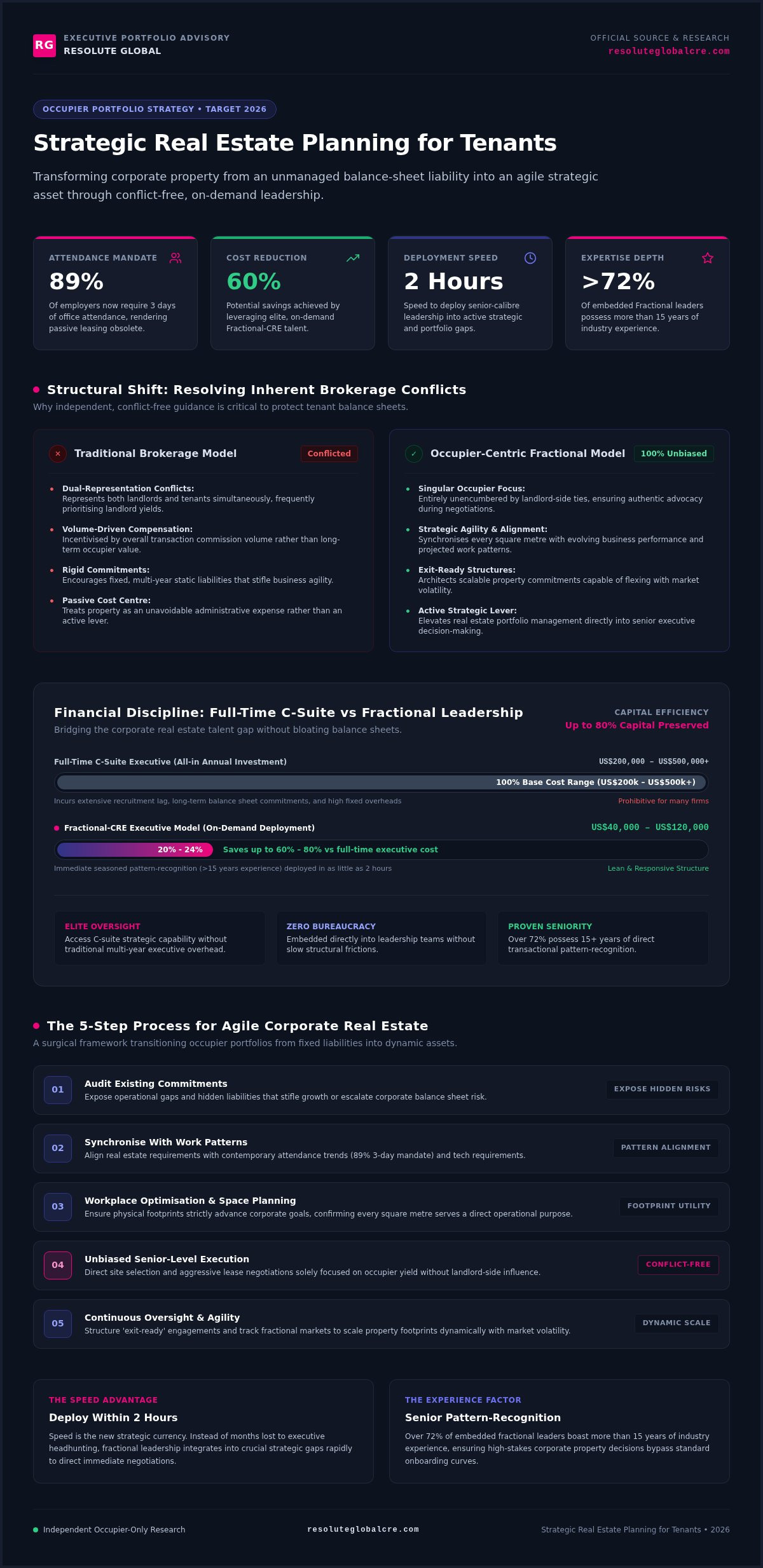
• Realise significant cost efficiencies by deploying senior experts for US$40k–US$120k, avoiding the US$200k–US$500k+ all-in cost of full-time C-suite hires.
What is Strategic Real Estate Planning for Tenants?
Strategic real estate planning for tenants represents a proactive shift in how organisations view their physical footprint. It's no longer sufficient to treat property as a static line item on the balance sheet. Instead, savvy leaders align their portfolios with long-term business objectives to drive competitive advantage. Strategic Real Estate Planning is the process of synchronising Corporate Real Estate assets with business agility and financial performance. This evolution transforms property from a passive 'cost centre' into an active 'strategic lever' for growth. Effective corporate real estate management ensures that every square metre serves a specific purpose in the company’s broader mission.
This process is inherently unique to occupiers. It requires a singular focus on the tenant's operational needs rather than the landlord's yield. To protect the organisation's interests, this strategy must remain entirely conflict-free. This independence allows for a transparent assessment of whether a space truly supports the workforce or merely drains capital. It's about being unencumbered by traditional industry ties.
The Rise of the Occupier-Focused Mandate
Traditional 'full-service' brokers often face significant conflicts of interest because they represent both landlords and tenants simultaneously. This dual representation can lead to advice that prioritises deal volume over client value. Business leaders today require straightforward, unbiased expertise that stands firmly on the occupier's side. When executing strategic real estate planning for tenants, companies must seek specialised pattern-recognition that generic consultants simply cannot provide. It demands a level of deep industry experience that understands how market shifts impact a tenant’s bottom line in real-time. By prioritising independent guidance, firms ensure their real estate strategy is built on integrity rather than commission-driven incentives.
A Framework for Occupier Portfolio Optimisation
Executing strategic real estate planning for tenants requires a surgical approach to portfolio health. Start by auditing existing commitments to expose gaps that stifle growth or escalate risk. You must then align your property requirements with projected work patterns and technological needs. This ensures your physical footprint supports workplace optimization and portfolio space planning rather than hindering it. Execution then moves to unbiased, senior-level talent who manage site selection and lease negotiations without landlord-side influence. Finally, maintain agility by monitoring the global fractional market to ensure your strategy evolves alongside your business. This continuous oversight prevents your property from becoming a fixed liability.
The 5-Step Process for Agile Corporate Real Estate
Transitioning from rigid, long-term leases to scalable property outcomes is essential for modern dynamism. This 5-step process is the foundation of strategic real estate planning for tenants who value speed and transparency. This framework prioritises 'exit-ready' engagements, allowing organisations to scale up or down based on market volatility. Speed is the new currency. Senior-calibre Corporate Real Estate talent can be deployed into strategic gaps in as little as two hours to accelerate this framework. It's a nimble alternative to traditional, slower structures. Whilst a full-time C-suite hire often costs between US$200k and US$500k+, the Fractional-CRE model provides elite expertise for US$40k to US$120k. This lean approach ensures you remain unencumbered and highly responsive. If you're ready to evolve, you can explore how Fractional-CRE leadership secures your advantage.
Executing Strategy with Fractional CRE Leadership
The Fractional-CRE Executive model serves as the world's first platform specifically engineered to bridge the senior talent gap. By integrating these experts directly into your leadership team, you move beyond routine lease management toward a sophisticated corporate real estate portfolio strategy. Strategic real estate planning for tenants requires more than just administrative oversight; it demands the seasoned pattern-recognition that comes from decades in the field.
Financial discipline remains a cornerstone of this approach. A traditional full-time C-suite hire often requires an all-in investment of US$200k to US$500k+, a figure that can be prohibitive for many firms. In contrast, the Fractional Executive model delivers elite leadership for US$40k to US$120k. This isn't just about cost savings. It's about access to excellence. Over 72% of these embedded leaders possess more than 15 years of experience, ensuring they deliver immediate strategic insights without the typical learning curve.
It's vital to distinguish these professionals from generic consultants or contractors. Fractional Executives are embedded leaders with defined authority and accountability. They don't offer arm's-length advice or carry hidden agendas. Instead, they operate as part of your internal structure, driving outcomes that align with your specific commercial goals.
The Agile Alternative to Traditional Hiring
The shift toward this model is undeniable, evidenced by a 5,400% growth in LinkedIn profiles mentioning 'fractional' since 2022. This trend reflects a broader move toward speed and independence in leadership roles. Whilst traditional hiring timelines stretch between 4 and 6 months, organisations can now engage proven talent in as little as two hours. With the global fractional market now valued at $5.7 billion, the model offers a reliable, surgical way to manage strategic real estate planning for tenants.
Master Your Portfolio Agility
The landscape of Corporate Real Estate has fundamentally shifted. Static leases are liabilities; dynamic portfolios are assets. By prioritising conflict-free guidance and auditing existing commitments, you ensure your space supports your business agility rather than hindering it. Strategic real estate planning for tenants is the essential mechanism for this transformation. Traditional hiring models are too slow and too expensive for the 2026 market. You can now access a global network of professionals with over 15 years of experience without the C-suite price tag. These fractional executives cost up to 60% less than traditional hires and can be deployed in a matter of hours. This is the surgical, unencumbered path to portfolio excellence. Secure conflict-free, senior-level expertise for your portfolio at Resolute Global and begin your transition today. Your strategic advantage is waiting.
Frequently Asked Questions
What is the difference between a Fractional CRE Executive and a consultant?
Fractional Executives are embedded leaders with defined authority and accountability, whereas consultants often provide arm's-length advice. They operate as part of your internal structure rather than being task-based contractors, ensuring transparency amongst your leadership team. This distinction is critical for strategic real estate planning for tenants, as it ensures the expert has no hidden agendas and acts with your interests in mind.
How quickly can a business engage a Fractional Head of Real Estate?
You can engage proven talent in as little as two hours. This rapid deployment contrasts sharply with the traditional C-suite hiring timeline, which typically stretches between four and six months. Such speed allows mid-market and global organisations to bridge strategic gaps immediately. It ensures your Corporate Real Estate strategy remains agile and highly responsive to volatile market shifts without unnecessary delays.
Is Fractional CRE more cost-effective than a full-time C-suite hire?
Yes, the Fractional model typically costs up to 60% less than a traditional hire. Whilst a full-time C-suite executive requires an all-in investment of US$200k to US$500k+, a Fractional Executive costs between US$40k and US$120k annually. This allows businesses to access elite expertise with over 15 years of experience while maintaining a lean, unencumbered balance sheet.
Why is conflict-free representation important for corporate tenants?
Conflict-free representation ensures that your adviser's interests are perfectly aligned with your own rather than a landlord's. Traditional brokers often represent both sides, which can lead to biased advice or inflated costs. For strategic real estate planning for tenants, having an independent specialist means every decision is focused solely on occupier advantage, transparency, and the elimination of dual-agency risks.
Proudly Untraditional
We’re proudly untraditional in the way we think, operate, and deliver value in the Corporate Real Estate sector.
Whether you’re a client seeking a new experience or an independent real estate adviser please get in touch to learn more.
More from the field
Keep reading for more sharp analysis on global corporate real estate