
Lease exit strategy for commercial tenants: reduce exit costs
Reducing dilapidations costs starts before handover: a lease exit strategy for commercial tenants should align the exit route with the lease terms and address repair obligations early. Break clauses commonly require 3 or 6 months’ notice, and the notice conditions must be followed precisely. Assignm...



Reducing dilapidations costs starts before handover: a lease exit strategy for commercial tenants should align the exit route with the lease terms and address repair obligations early. Break clauses commonly require 3 or 6 months’ notice, and the notice conditions must be followed precisely. Assignment, a negotiated surrender or staying to lease expiry may offer different routes, each with distinct responsibilities and costs.
When a commercial lease is ending, it’s easy to focus on the premises’ condition. But your exit route, timing and lease obligations can all affect the final cost.
This article explains how break clauses, assignment and surrender work, what to consider when planning for dilapidations, and how occupier-focused advice can help you make a more informed exit decision.
Key Takeaways
• Map your break clause’s notice and conditions carefully; a technical error could undermine your exit plan.
• Weigh lease assignment against the obligations that may remain with you, including an authorised guarantee agreement.
• Address repair obligations and dilapidations early to understand how the premises’ condition could affect your final costs.
• Occupier-focused advice can help bring lease terms, exit options and handover priorities into one clear strategy.
Break clauses and notice
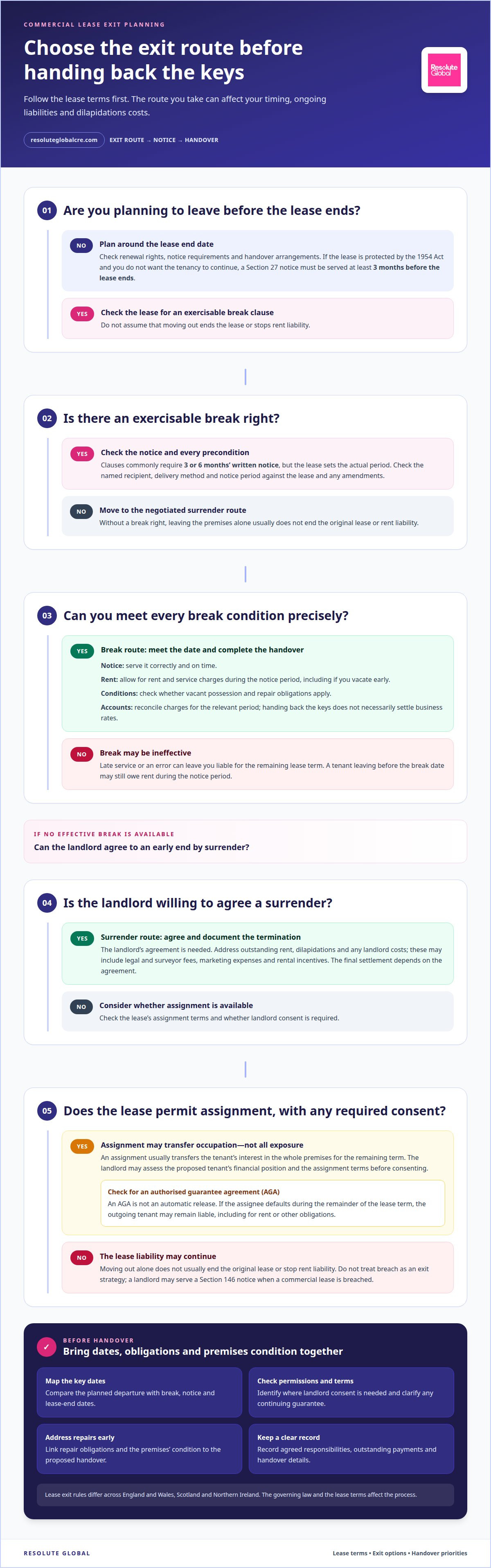
A lease exit strategy for commercial tenants should align the intended departure with the lease’s break provisions and notice requirements. Without an exercisable break right, leaving the premises may not end your ongoing liabilities.
Leaving Without a Break Clause
Without a break clause, moving out alone usually doesn’t end the original lease or stop rent liability. Moving out may not end the tenant’s rent liability unless the landlord agrees to an early end. A negotiated surrender is an alternative, but it needs the landlord’s agreement and documents recording the termination. The National Archives states that a landlord may serve a Section 146 notice when a tenant breaches a commercial lease, putting the lease at risk of termination. Breach isn’t an exit strategy.
Break Clause Timing and Preconditions
A break clause sets when a tenant may end the lease and the conditions to meet. Clauses commonly require 3 or 6 months’ written notice, though the lease sets the actual period. The tenant may need to pay rent up to the break date, give vacant possession and meet repair obligations. A tenant who leaves before that date may still owe rent during the notice period. Treat each precondition as essential.
Notice Validity
A break notice is valid only if it follows the lease’s requirements precisely. Clauses may specify the recipient, delivery method and notice period. Late service or an error can make the break ineffective, leaving the tenant liable for the remaining lease term. For a lease exit strategy for commercial tenants, allow time to compare the notice against the original lease and amendments. In England, a tenant ending a commercial lease after a fixed-term tenancy has ended must usually give 3 months’ notice, according to The National Archives.
Rent and Other Exit Liabilities
Rent and service charges may remain payable during the notice period, even if you vacate early. The lease sets out which charges continue and when liability ends. Business rates need separate attention: handing back the keys does not necessarily settle the account. Record the break date, final occupation and handover, then reconcile the charges for the relevant period. This helps clarify which liabilities remain after departure.
Does assigning a lease require a personal guarantee?
Not automatically. A landlord may require the outgoing tenant to support the incoming tenant’s obligations through an authorised guarantee agreement. Assignment can transfer occupation, but it does not always end the original tenant’s financial exposure.
Assigning a Lease to a New Tenant
An assignment transfers a tenant’s interest in a commercial property lease to a new tenant, usually for the whole premises and the remaining term. The lease must permit assignment, and landlord consent is generally required. The landlord may assess the proposed tenant’s financial position and the terms of the assignment before consenting. This route may suit a business that wants to leave rather than continue leasing the space, but consent requirements and any guarantee can affect the deal. A solicitor can document the assignment and clarify responsibility for rent and dilapidations.
Authorised Guarantee Agreements
An authorised guarantee agreement (AGA) is a guarantee under which the outgoing tenant may remain liable if the assignee defaults during the remainder of the lease term. If the new tenant fails to pay rent or meet other obligations, the landlord may require the former tenant to pay or take a new lease. An AGA is not an automatic release. Assess its terms alongside the proposed tenant’s financial position when considering the risks of assignment.
Lease exit rules differ across England and Wales, Scotland and Northern Ireland. The governing law and the lease terms affect the process. In England and Wales, a commercial sublease must expire before the original lease ends.
To negotiate a surrender, propose a documented termination by agreement and address outstanding rent, dilapidations and any landlord costs. These may include legal and surveyor fees, marketing expenses and rental incentives. The final settlement depends on the agreement.
Insolvency, forfeiture and a company voluntary arrangement are distinct processes, not simple alternatives to an agreed lease exit. Their effects on ongoing lease liabilities depend on the relevant legal process and lease obligations.
For a clearer occupier-side view of assignment exposure and exit options, explore occupier-focused lease advice.
Commercial lease advisory for occupiers
An occupier’s exit plan should connect the lease end date with renewal rights, notice requirements and handover arrangements. A lease exit strategy for commercial tenants is more robust when these obligations are considered alongside the planned departure and future property needs.
In England, a landlord must usually give 6 months’ notice to end a commercial lease after a fixed-term tenancy has ended, according to The National Archives. Under the Landlord and Tenant Act 1954, a Section 25 notice must state whether the landlord opposes renewal and, if so, the grounds for termination, according to The National Archives. The notice can affect whether renewal or ending the tenancy is in prospect. Consider its terms alongside the lease’s break rights and any proposed surrender.
Occupier-focused advice can bring contractual and operational obligations into a single exit plan. This may involve mapping key dates, identifying where landlord consent is needed, and linking repair obligations to the proposed handover. Keep a clear record of agreed responsibilities, outstanding payments and the premises’ condition. Starting the review early leaves more room to discuss surrender terms before the planned departure becomes urgent.
For a lease protected by the 1954 Act, a tenant who does not want the tenancy to continue must serve a Section 27 notice at least three months before the lease ends, according to The National Archives. A lease exit strategy for commercial tenants should align that notice with the lease’s status, the intended exit and any landlord discussions. The priority is a coherent view of obligations, dates and decisions.
Resolute Global
Resolute Global provides occupier-focused CRE guidance for businesses weighing a break, assignment, surrender or lease expiry. Seek occupier advice when lease obligations, renewal decisions and dilapidations need to be considered together, or when the right exit route is unclear.
Its Conflict-free Real Estate Solutions and Global Real Estate Advisory Network support an occupier-centred perspective on commercial property decisions. The aim is to clarify the choices, obligations and trade-offs shaping your exit, so you can make decisions with a sharper view of their implications.
Contact Resolute Global to discuss your commercial lease exit.
Shape your next property decision
An exit is also an opportunity to reassess how your organisation approaches its next property commitment. Before agreeing new terms, consider which obligations could restrict future change, how repair responsibilities are framed, and whether the lease offers practical flexibility as your business needs evolve. Aligning property decisions with operational plans can help you avoid carrying unsuitable terms into the next phase.
A lease exit strategy for commercial tenants should support more than a handover; it should help the organisation make its next decision with a clear view of its priorities. Resolute Global brings an occupier-centred perspective to commercial property choices. If you’re assessing a move, renewal or future lease, discuss your commercial property plans with Resolute Global. Start the next conversation with a clearer brief and a more deliberate view of your options.
Frequently Asked Questions
Can dilapidations costs be reduced at lease end?
Yes, early planning can help identify avoidable work and clarify which repairs relate to your lease obligations. A detailed lease-end assessment around 12 months before expiry can flag reinstatement issues and help prioritise remedial work. Keep records of alterations and the property’s condition, so discussions about the schedule of works can focus on evidence rather than assumptions.
How much notice do I need to give before ending my commercial lease?
It depends on whether you’re exercising a break clause or ending a tenancy after its fixed term. Break clauses commonly require 3 or 6 months’ notice, but the lease sets the applicable period and service conditions. In England, a tenant ending a commercial lease after a fixed-term tenancy has ended must usually give 3 months’ notice. Distinguish these routes before setting a departure date.
Should I seek legal advice?
Yes, particularly before serving a break notice, agreeing to an assignment or signing a surrender. Legal advice can clarify the document wording, notice service requirements and continuing liabilities. For example, an assignment may not remove exposure under an authorised guarantee agreement. Advice is especially useful when exit terms, outstanding rent and dilapidations need to be documented together.
What happens if I leave without restoring the property?
The landlord may pursue a dilapidations claim for work required under the lease, and the claim may include lost rent during remedial works. Leaving without documenting the premises’ condition or completing agreed reinstatement can make a final dispute harder to resolve. Keep evidence of completed works and the handover, and record any agreed outstanding items in writing.
What are the most common mistakes tenants make at the end of a commercial lease?
Common mistakes include relying on a moving date rather than the lease termination date, overlooking notice service requirements, and assuming landlord consent is automatic. Tenants may also miss reinstatement obligations or leave payments unresolved at handover. Coordinate the notice, consent documents, repair work and final inspection to avoid one missed item complicating the exit.
Proudly Untraditional
We’re proudly untraditional in the way we think, operate, and deliver value in the Corporate Real Estate sector.
Whether you’re a client seeking a new experience or an independent real estate adviser please get in touch to learn more.
More from the field
Keep reading for more sharp analysis on global corporate real estate