
Multi-market property strategy: a practical guide
What if managing Corporate Real Estate across multiple markets didn’t mean choosing between central control and local relevance? A Multi-market real estate strategy for businesses can connect property decisions to shared priorities while allowing for the needs of each market. Fragmented decisions an...


What if managing Corporate Real Estate across multiple markets didn’t mean choosing between central control and local relevance? A Multi-market real estate strategy for businesses can connect property decisions to shared priorities while allowing for the needs of each market. Fragmented decisions and lean central teams can make that balance difficult to achieve.
The answer isn’t necessarily a permanent senior hire or a one-size-fits-all model. A clear portfolio direction helps leaders make joined-up decisions and adapt senior CRE expertise as requirements change. This guide explains how to align strategy across markets, compare operating approaches and maintain visibility of portfolio priorities, risks and business needs. It also considers how flexible senior leadership can help when your organisation needs deeper CRE capability without locking it into a fixed structure.
Key Takeaways
• Build a Multi-market real estate strategy for businesses around shared priorities, then shape decisions to fit each market.
• Compare centralised, market-led and coordinated operating approaches by how well they balance strategic oversight with local context.
• Clarify where portfolio-wide visibility can reveal competing priorities, risks and trade-offs before they undermine business goals.
• Consider how an embedded Fractional-CRE Executive can provide flexible senior leadership, with engagements completed in two hours cited.
Why multi-market real estate strategy matters to business occupiers
A property decision in one market can affect more than a local workplace. It may shape investment priorities, operational capacity and decisions elsewhere in the portfolio. A Multi-market real estate strategy for businesses gives leaders a way to weigh those connections instead of assessing each location in isolation.
A multi-market Corporate Real Estate strategy coordinates portfolio decisions around business priorities while adapting choices to the needs of each market. Without that shared view, local decisions can compete for investment, duplicate effort or expose risks that are difficult to see across separate teams. The aim isn’t uniformity. It’s a coherent direction with room for informed local judgement.
What should a multi-market CRE strategy align?
Start by connecting property choices to business objectives, operating needs and leadership priorities. Then decide which matters need portfolio-wide oversight and where market context should shape the outcome. This gives leaders a consistent basis for comparing options rather than relying on disconnected local preferences. For each decision, record its business objective, who owns it and whether local factors change the preferred outcome.
Shared priorities
Set the outcomes and decision principles that apply across the portfolio, including how property choices support business plans.
Central oversight
Make portfolio-wide trade-offs visible, including how competing priorities affect investment and risk.
Local context
Let market-specific conditions and operational requirements inform the choice of solution in each location.
For example, a business may want a consistent approach to workplace capacity across its portfolio, yet make different property decisions market by market. One location may need a different arrangement from another because its operational requirements or available options differ. The strategy keeps the rationale connected, even when the outcomes aren’t identical.
Evaluating property through market conditions, use and long-term value reflects principles discussed in Real Estate Investing Principles. For occupiers, those considerations also need to sit alongside business priorities. This is what makes a Multi-market real estate strategy for businesses useful in practice: it supports clear oversight without forcing every market into the same decision.
How to compare multi-market real estate operating approaches
The right operating approach depends on where your organisation needs consistency and where decisions benefit from local knowledge. Compare approaches against strategic alignment, market responsiveness, senior CRE capability and the flexibility to adjust as business needs evolve. A Multi-market real estate strategy for businesses should make these trade-offs explicit, rather than defaulting to the most centralised or decentralised structure.
| Approach | Trade-off | Leadership question |
|---|---|---|
| Centralised oversight | Supports consistent priorities and portfolio visibility, but can be less responsive to local operating requirements. | Which decisions genuinely need one portfolio-wide view? |
| Market-led decisions | Uses local insight and can enable market-level responsiveness, but may make priorities and risks harder to compare across the portfolio. | How will local choices remain aligned with business objectives? |
| Coordinated model | Combines shared direction with local judgement, but requires clear decision rights and strong communication. | Who sets the common principles, and who adapts them in each market? |
Which decision rights should stay central, and which should flex by market?
Keep portfolio priorities, decision principles and oversight of cross-market trade-offs central. Allow choices shaped by local operating requirements to flex within those agreed parameters. Make the dividing line explicit: unclear authority can lead to duplicated work or delayed decisions. A useful test is whether a decision changes shared priorities or creates a portfolio-wide trade-off. If it does, central oversight matters; if it depends on local operating requirements, allow for market judgement within the agreed direction.
Put the model into practice with three disciplines:
Assign accountability
Name who recommends, approves and delivers each category of decision.
Set escalation routes
Define how local exceptions or portfolio-wide risks reach the right decision-maker.
Review the portfolio
Use regular reviews to test decisions against business priorities and changing requirements.
There’s no universal blueprint. The test is whether the model gives leaders the oversight, local context and senior capability their organisation needs. Resolute Global’s occupier-focused CRE guidance is designed to provide unbiased support for tenants and occupiers.
When a Fractional-CRE Executive can support a multi-market strategy
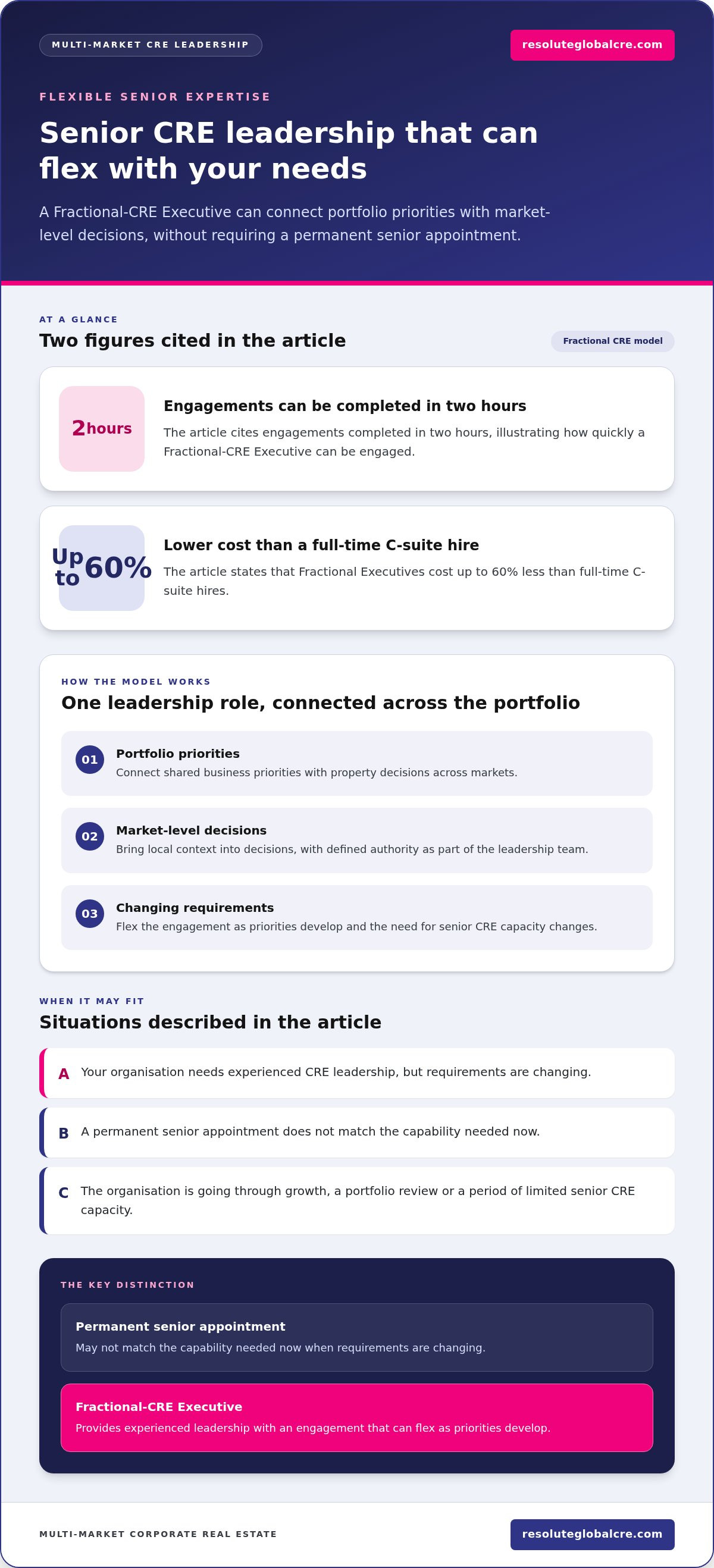
A Fractional-CRE Executive can suit an organisation that needs experienced CRE leadership but has changing requirements, or for which a permanent senior appointment doesn’t match the capability needed now. In a multi-market setting, an embedded executive can connect portfolio priorities with market-level decisions, working with defined authority as part of the leadership team.
This model can support a period of growth, a portfolio review or a stretch when senior CRE capacity is limited. The engagement can flex as priorities develop, providing an alternative to a permanent hire when the need for leadership may change. Fractional-CRE Executives can be engaged in a matter of hours, with engagements completed in two hours cited.
Fractional Executives cost up to 60 % less than full-time C-suite hires. The annual ranges are Fractional Executive, US$40k-US$120k, and full-time C-suite, US$200k-US$500k+. These figures can help leaders compare the models against the organisation’s leadership requirements and the duration of its need.
What does flexible senior CRE leadership make possible?
Resolute Global’s Fractional-CRE Executive model draws on a curated community of former Corporate Real Estate Executives. > 72 % of Fractional Executives have 15+ years of experience. That depth can support informed leadership across markets, while flexible, scalable and exit-ready engagements allow the level of support to adapt as business needs shift.
For a Multi-market real estate strategy for businesses, this model can bring senior oversight to the moments that need it without assuming every organisation needs the same permanent structure. Define the executive’s authority, priorities and relationship with internal teams at the outset, so leadership is embedded in the decisions it’s there to guide.
Turn your portfolio direction into your next decision
A strategy earns its value when it helps leaders make the next important property decision with confidence. Choose an upcoming portfolio question and use it to test whether your priorities, decision-making authority and market insight are working together. That practical test can show where your approach is clear and where it needs to evolve.
A Multi-market real estate strategy for businesses isn’t a fixed blueprint. It should stay connected to business direction as requirements shift, giving leaders a basis for action rather than adding another layer of process. Start with the decision in front of you, then use what it reveals to assess the wider portfolio.
To discuss your CRE priorities with Resolute Global, visit Resolute Global or get in touch: www.ResoluteGlobalCRE.com; james.mclean@resoluteglobalcre.com; +44 7867 140785.
Frequently Asked Questions
Does every market need the same Corporate Real Estate strategy?
No. Markets can follow the same business outcomes and decision principles without using identical property solutions. For example, a shared objective to support effective operations may lead to different workplace choices where workforce patterns or local operating needs vary. Review those differences against agreed portfolio priorities so each local adaptation has a clear rationale rather than becoming an isolated decision.
Can a business coordinate several markets without a large permanent CRE team?
Yes. A lean internal team can retain ownership of priorities and draw on flexible senior CRE leadership when a capability gap or portfolio challenge arises. For example, an organisation planning changes across several markets could give an embedded executive a defined role in leadership decisions while internal teams contribute operational knowledge. The Multi-market real estate strategy for businesses should make responsibilities clear, regardless of team size.
How quickly can a Fractional-CRE Executive be engaged?
Fractional-CRE Executives can be engaged in a matter of hours, with engagements completed in two hours cited. That speed can matter when a business faces a leadership gap or needs experienced CRE input for an emerging decision. Define the executive’s authority, remit and relationship with internal decision-makers as part of setting up the engagement.
Who should sponsor a multi-market real estate strategy?
A senior leader with influence across business priorities should sponsor the strategy. The CEO, CFO or COO may be well placed to connect property decisions to organisational direction. The CRE lead, where there is one, can coordinate development and execution. Involve market and functional leaders early so operational requirements, investment priorities and decision ownership are understood before choices are made.
Proudly Untraditional
We’re proudly untraditional in the way we think, operate, and deliver value in the Corporate Real Estate sector.
Whether you’re a client seeking a new experience or an independent real estate adviser please get in touch to learn more.
More from the field
Keep reading for more sharp analysis on global corporate real estate


