
Global Workplace Strategy: Align Your Workplace with Business Goals
What makes a global workplace strategy effective? Not making every office the same, but setting clear principles that each location can apply to its needs. Workplace decisions must support business priorities, yet global standards can overlook local teams, markets and ways of working. The result can...



What makes a global workplace strategy effective? Not making every office the same, but setting clear principles that each location can apply to its needs. Workplace decisions must support business priorities, yet global standards can overlook local teams, markets and ways of working. The result can be choices disconnected from employee needs and Corporate Real Estate priorities.
A stronger approach connects the two. This article sets out a practical framework for aligning workplace plans with business outcomes, balancing shared principles with local insight and making informed occupancy decisions. It also explains how occupier-focused Corporate Real Estate expertise and Fractional-CRE can support those choices. The aim is clear global direction with locally informed decisions.
Key Takeaways
• Use a global workplace strategy to connect work patterns and workplace choices to measurable organisational priorities.
• Define the outcomes workplace decisions should support, rather than treating a list of office changes as a strategy.
• Build a practical sequence: understand work patterns, assess portfolio needs, set principles and review progress.
• Apply shared global direction with locally informed decisions, drawing on occupier-only Corporate Real Estate expertise where needed.
What Is a Global Workplace Strategy, and What Should It Achieve?
A global workplace strategy aligns workplace decisions and work patterns with organisational priorities across markets. It helps leaders consider how people work, where they need to work and what the organisation’s portfolio must support, rather than treating each office as a separate decision.
That distinction matters. A list of office changes, new tools or property transactions describes activity; it does not explain what those choices should achieve. A strategy connects them to outcomes such as supporting business transformation, responding to employee needs, improving efficiency, reducing risk and maintaining flexibility as the organisation changes. The workplace strategy framework also links workspace design, Corporate Real Estate and work patterns to organisational performance.
For occupiers, this means considering the full occupancy lifecycle: understanding requirements and assessing space, making location and lease decisions, then reviewing whether the workplace continues to serve the business. The aim is not uniformity for its own sake. It is a coherent direction that supports informed local choices.
Which business questions should the strategy answer?
Start by identifying where workplace arrangements no longer meet organisational needs, what is changing and which outcomes matter. Use questions such as:
• Which work activities need in-person collaboration, and which can happen elsewhere?
• Where do employees need different support to do their work effectively?
• How should occupancy decisions respond to growth, transformation or uncertainty?
• What evidence will show whether workplace choices are delivering the intended results?
A global workplace strategy helps occupiers make workplace and Corporate Real Estate decisions that support business priorities and the people who deliver them.
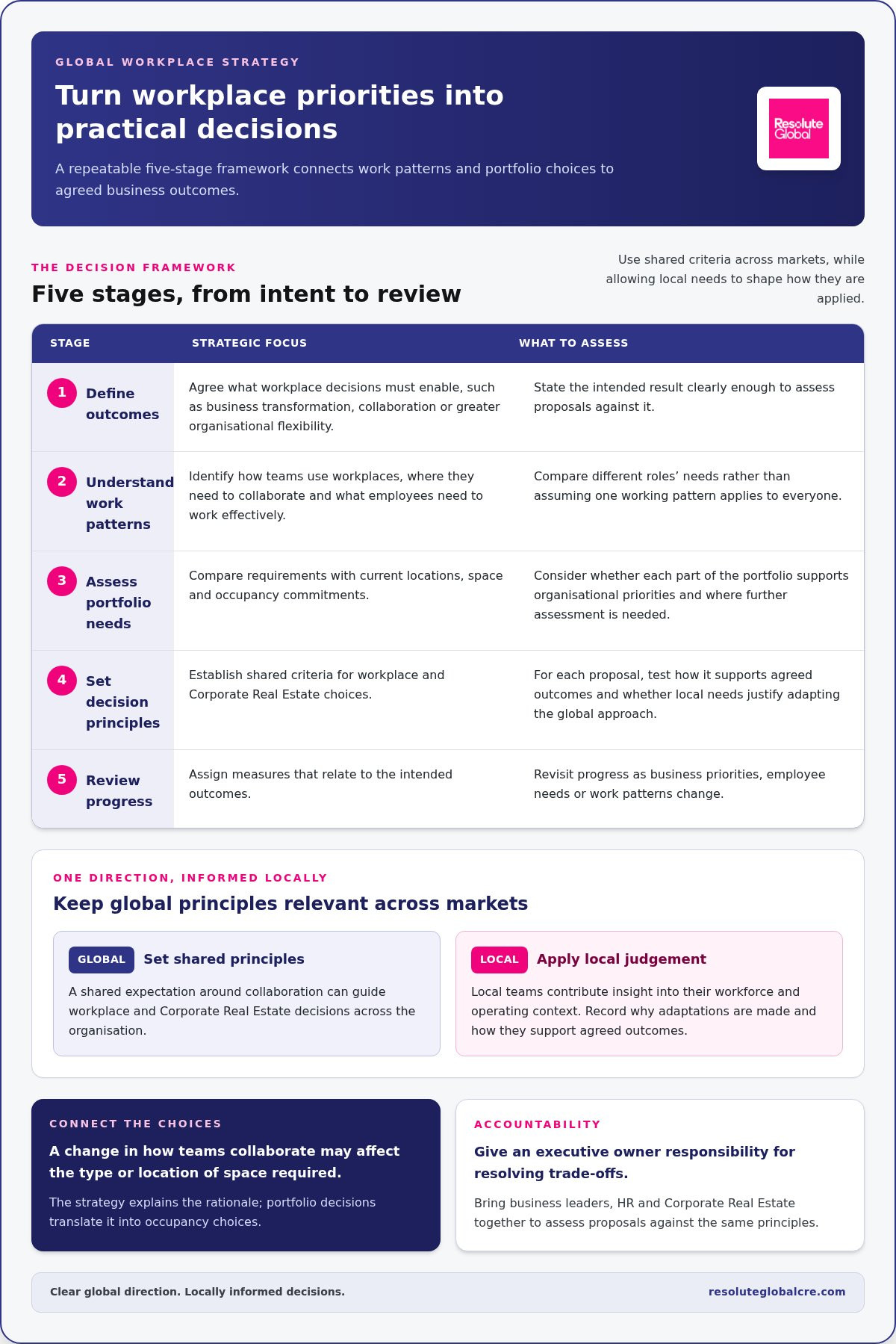
How to Turn Global Workplace Priorities into a Practical Strategy
Turn intent into decisions through a repeatable sequence. A global workplace strategy should give leaders enough structure to connect work patterns with portfolio choices, without prescribing identical solutions everywhere.
Define outcomes.
Agree what workplace decisions must enable, such as business transformation, collaboration or greater organisational flexibility. State the intended result clearly enough to assess proposals against it.
Understand work patterns.
Identify how teams use workplaces, where they need to collaborate and what employees need to work effectively. Compare the needs of different roles rather than assuming one working pattern applies to everyone.
Assess portfolio needs.
Compare those requirements with current locations, space and occupancy commitments. Consider whether each part of the portfolio supports the organisation’s priorities and where further assessment is needed.
Set decision principles.
Establish shared criteria for workplace and Corporate Real Estate choices. For each proposal, ask how it supports agreed outcomes and whether local needs justify adapting the global approach.
Review progress.
Assign measures that relate to the intended outcomes and revisit them as business priorities, employee needs or work patterns change.
Connect workplace priorities to portfolio decisions by asking what each choice enables. For example, a change in how teams collaborate may affect the type or location of space required. The strategy explains the rationale; portfolio decisions translate it into occupancy choices.
How can leaders keep a global strategy relevant across markets?
Set global principles, then be explicit about where local judgement applies. A shared expectation around collaboration can guide decisions, while local teams contribute insight into their workforce and operating context. Record the reason for local adaptations and how they support the agreed outcomes. Give an executive owner responsibility for resolving trade-offs, and bring business leaders, HR and Corporate Real Estate together to assess proposals against the same principles. This creates accountability without imposing a single template.
For a broader occupier perspective on aligning property decisions with business needs, explore this occupier property advisory strategic guide. Resolute Global provides occupier-focused Corporate Real Estate guidance to help leaders shape decisions around their priorities.
How Agile, Occupier-Only Corporate Real Estate Expertise Supports Delivery
A workplace strategy creates value when it informs real occupancy decisions. Senior Corporate Real Estate expertise can help leaders interpret business priorities, assess the implications for the organisation’s footprint and connect strategic intent with choices across the occupancy lifecycle. An occupier-only perspective keeps advice focused on the needs of the organisation occupying the property.
Resolute Global provides occupier-only advice through a curated guild of independent Corporate Real Estate experts. Its expert-agnostic approach brings together a team suited to each assignment, drawing on a global network of independently owned local firms. This gives organisations access to flexible expertise and practical insight for their Corporate Real Estate priorities.
When can Fractional-CRE support be useful?
Fractional-CRE gives organisations flexible access to senior expertise when they need experienced Corporate Real Estate leadership without a permanent hire. It can support a business reassessing occupancy, working through organisational change or building the capability to progress workplace priorities. More than 72% of Fractional Executives have 15+ years of experience.
Fractional Executives bring senior expertise into the organisation; they are not task-based contractors. Their leadership can help connect workplace priorities to practical, occupier-focused decisions. For more context on this model, explore the fractional corporate property strategic guide.
If your global workplace strategy needs experienced, occupier-only Corporate Real Estate input, explore Resolute Global’s approach. Contact James McLean at james.mclean@resoluteglobalcre.com or +44 7867 140785.
Make your next workplace decision count
A global workplace strategy should be a living reference, not a document that loses relevance after approval. As priorities evolve, use significant workplace decisions to test whether existing principles still serve the organisation and its people. Where local needs call for a different response, record the reason and how the decision fits the wider direction. That discipline keeps choices grounded and accountable.
Start with an upcoming occupancy or workplace decision. Ask what outcome it should support, whose needs it affects and what it could mean for the organisation’s direction. The answers can clarify where to act now and what needs further attention. Progress begins with a clear decision.
Discuss your global workplace strategy with James McLean at james.mclean@resoluteglobalcre.com or +44 7867 140785. Visit www.ResoluteGlobalCRE.com to learn more about Resolute Global’s Corporate Real Estate guidance.
Frequently Asked Questions
Who should be involved in creating a global workplace strategy?
Bring together an executive sponsor and the people who understand how work happens and how property decisions are made. This often includes Corporate Real Estate, finance, HR, operations and technology, alongside representatives from local teams. Give each participant a clear role: executives set direction, specialists assess implications, and employees share insight into how workplace arrangements affect day-to-day work.
How often should a global workplace strategy be reviewed?
Set a regular review point that fits your organisation’s planning cycle, then revisit the strategy when a major change could affect its assumptions. A merger, a shift in workforce plans or a significant change to how teams collaborate may warrant an earlier review. This keeps the strategy responsive without turning every operational adjustment into a full strategic reset.
Can a global workplace strategy support different needs across markets?
Yes. A strategy can provide common direction while allowing local teams to adapt how it is applied. A shared aim to support collaboration, for example, might lead to different workplace arrangements for teams with distinct roles or working patterns. Make adaptations transparent by recording the need they address and how they align with the organisation’s wider priorities.
What should leaders measure to understand whether a workplace strategy is working?
Choose measures that reflect the outcomes the organisation wants, rather than tracking activity for its own sake. Leaders might assess employee feedback, patterns of workplace use, whether space suits key tasks and progress against occupancy plans. Consider these measures together: increased use alone may not indicate success if employees still report that the environment makes collaboration or focused work difficult.
Proudly Untraditional
We’re proudly untraditional in the way we think, operate, and deliver value in the Corporate Real Estate sector.
Whether you’re a client seeking a new experience or an independent real estate adviser please get in touch to learn more.
More from the field
Keep reading for more sharp analysis on global corporate real estate