
Tenant Rep vs Dual Agency: A Strategic Occupier Guide
Many corporate occupiers believe that partnering with a full-service global firm provides the widest market access, yet this perceived scale often masks a structural conflict that functions as a hidden tax on your lease. You've likely experienced the unease of a negotiation where the market data fee...


Many corporate occupiers believe that partnering with a full-service global firm provides the widest market access, yet this perceived scale often masks a structural conflict that functions as a hidden tax on your lease. You've likely experienced the unease of a negotiation where the market data feels curated and your requirements feel like a one-off transaction compared to the landlord's recurring portfolio. It's a common frustration in a market where transparency is often sacrificed for internal brokerage commissions.
Understanding the fundamental divide of tenant representation vs dual agency is essential to reclaiming your leverage at the negotiating table. This guide explores the structural differences between Exclusive Advocacy and the compromised nature of dual agency to ensure your strategy remains unencumbered and cost-effective. We will examine the implications of the latest RICS professional statement updates for 2026 and demonstrate how a conflict-free partner provides the absolute loyalty, strategic precision, and financial clarity required to lower your total occupancy costs whilst driving long-term value.
Key Takeaways
• Understand the fundamental distinction between tenant representation vs dual agency to protect your firm from compromised negotiations and hidden costs.
• Identify why traditional full-service models often prioritise repeat landlord relationships over one-off occupier transactions, creating a structural disadvantage for your business.
• Navigate the stringent RICS professional standards that ban dual agency in the UK, ensuring your advisor maintains absolute fiduciary loyalty.
• Discover how conflict-free data transparency provides access to authentic off-market insights that traditional brokers might withhold to protect landlord interests.
• Explore how Fractional CRE services provide senior-level expertise and global reach without the full-time overhead of traditional bureaucracies.
Defining the Divide: Tenant Representation and Dual Agency Explained
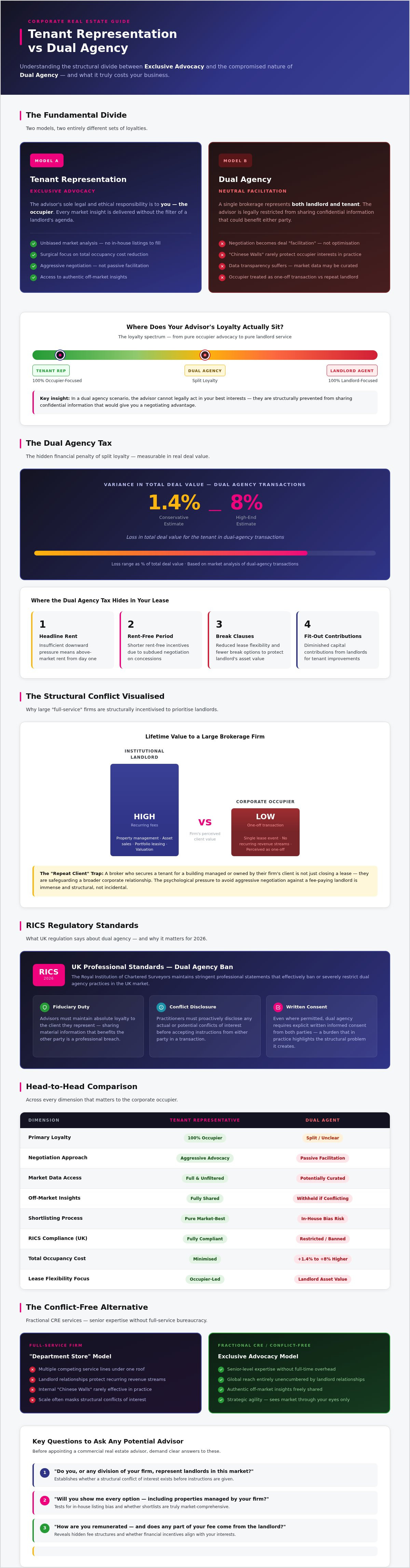
Choosing an advisor is the most consequential decision in any property acquisition or lease renewal. The debate regarding tenant representation vs dual agency isn't merely a matter of preference; it's a fundamental choice between absolute fiduciary loyalty and a structural compromise. Tenant representation functions as an Exclusive Advocacy model, where the advisor's sole responsibility is to the occupier. Conversely, dual agency occurs when a single brokerage firm attempts to represent both the landlord and the tenant in the same transaction. This creates a "Neutral Facilitation" environment that inherently limits the advisor's ability to fight for your best interests.
The Role of the Tenant Representative
A dedicated tenant representative operates as a Strategic Global Specialist, unburdened by the need to protect landlord revenue streams. In the context of tenant representation vs dual agency, the former ensures that every market insight is delivered without the filter of a landlord's agenda. These advisors provide unbiased market analysis because they have no "in-house" listings to fill. This independence allows for a surgical focus on total occupancy cost reduction and lease flexibility. They align property decisions with your specific business growth objectives, ensuring every square foot serves your bottom line. It's about aggressive negotiation, not passive facilitation.
The Mechanism of Dual Agency
Dual agency shifts the advisor's role from an advocate to a middleman. When a firm represents both sides, they're legally and ethically restricted from sharing confidential information that could give one party an advantage. Negotiation becomes "facilitation," a process designed to close the deal rather than optimise the terms for the occupier. Large, multi-disciplinary firms often rely on "Chinese Walls" to separate their landlord and tenant teams. However, these internal barriers rarely protect the occupier's interests in practice. Data transparency suffers, and the occupier often feels like a one-off transaction compared to the landlord, who represents repeat business and massive portfolio fees for the firm.
The distinction is frequently blurred by the "Full-Service" bureaucracies that dominate the market. They pitch the convenience of a global reach whilst downplaying the inherent conflicts of interest. True strategic agility requires an advisor who is entirely unencumbered. You need a partner who sees the market through your eyes, not through the lens of a landlord's asset management plan. This clarity is the only way to ensure your corporate real estate strategy remains uncompromised and cost-effective.
The Structural Conflict: Why Dual Agency Penalises the Occupier
Dual agency isn't just a process; it's a revenue strategy for large brokerage firms. When examining tenant representation vs dual agency, the financial incentives are heavily weighted towards the landlord. Most global firms operate as "department stores" of real estate, housing property management, building sales, and leasing teams under one roof. This structure creates a fundamental conflict. Landlords are repeat customers who provide millions in recurring fees, whilst tenants are often perceived as one-off transactions. This disparity in lifetime value inevitably dictates where a firm's true loyalty lies.
The "Repeat Client" Trap
Large firms instinctively protect relationships with major institutional landlords because these clients drive consistent revenue across multiple service lines. If a broker secures a tenant for a building managed or owned by their firm's client, they're not just closing a lease; they're safeguarding a broader corporate relationship. This bias manifests in the shortlisting process, where "in-house" listings might be prioritised over superior market alternatives. The psychological pressure on an agent is immense; they're unlikely to aggressively negotiate against a landlord who pays their firm's property management bills every month. For truly conflict-free real estate solutions, occupiers must look beyond these compromised structures.
Quantifying the Cost of Conflict
The financial penalty of split loyalty is significant. Market analysis indicates that dual-agency transactions often result in lower financial outcomes for the tenant, with some studies showing a variance of 1.4% to 8% in total deal value. This "Dual Agency Tax" isn't always visible in the headline rent; it hides in the details of the lease. You might receive a shorter rent-free period, a less generous fit-out allowance, or more restrictive break clauses. Listing brokers are contractually bound to achieve the highest possible return for the landlord, making it impossible for them to simultaneously secure the lowest cost for you.
The Dual Agency Tax is the quantifiable financial and strategic loss an occupier incurs when their interests are secondary to an advisor's landlord-driven revenue goals.
Beyond the direct costs, there's the issue of data transparency. In a dual-agency scenario, the broker cannot share certain market intelligence that would give the tenant an upper hand. They're forced into a state of "neutral facilitation," which effectively strips the occupier of their competitive edge. Only a specialised partner can provide the unencumbered market data required to drive a hard bargain.
Regulatory Reality and the RICS Standard in the UK
The regulatory landscape for UK commercial property changed fundamentally on 1 January 2018. The Royal Institution of Chartered Surveyors (RICS) issued a Professional Statement titled "Conflicts of Interest - UK Commercial Real Estate", which effectively outlawed the practice of dual agency in its most blatant form. For occupiers, understanding the nuances of tenant representation vs dual agency is no longer just about strategy; it's about knowing your rights under a rigorous ethical framework. A Chartered Surveyor is now prohibited from representing both a buyer and a seller, or a landlord and a tenant, on the same transaction. This mandate was designed to restore integrity to a market that had become dangerously opaque.
The RICS 2018 Mandate
This prohibition was a direct response to the structural flaws inherent in full-service brokerage models. It requires firms to be entirely transparent about potential conflicts and to manage them with surgical precision. Despite this, many corporate occupiers remain unaware that these protections exist. The mandate ensures that an advisor cannot serve two masters simultaneously on a single deal, yet the industry has developed sophisticated workarounds that often leave the tenant at a disadvantage. Compliance with the letter of the law does not always equate to a commitment to the occupier's advantage.
The "Informed Consent" Grey Area
The most common workaround is the "Informed Consent" clause. Firms often present complex disclosure forms that function as a legal waiver, asking you to agree to a potential conflict in exchange for market access. This is a critical point in the tenant representation vs dual agency debate. A legal waiver is not a strategic advantage. Whilst it might satisfy the RICS requirement for transparency, it doesn't solve the underlying loyalty issue. Truly conflict-free firms refuse to seek this consent because their business model is built on the principle that loyalty cannot be shared. They don't just manage conflicts; they eliminate them by choosing to represent only one side of the market.
Ethical standards for UK surveyors are high, yet the pressure of landlord-driven revenue often stretches these boundaries. The anticipated 2026 updates to the RICS professional statement are expected to further tighten these rules, reflecting a global shift towards a more transparent, Occupier-centric philosophy. Relying on an advisor who asks for permission to be conflicted is a risk your corporate real estate strategy doesn't need to take. True advocacy requires an unencumbered partner who never has to ask for a waiver to do their job.
The Financial and Strategic Cost of Split Loyalty
The choice between tenant representation vs dual agency is often framed as a simple selection of a service provider, yet the strategic implications go much deeper. Full-service brokers operate within a model that prioritises transaction volume and landlord retention. In contrast, occupier-only specialists focus on the surgical alignment of real estate with corporate strategy. This difference is most visible in how market intelligence is handled. Whilst large firms claim that their massive scale provides better data, the reality is that this information is often siloed or filtered to prevent undermining their landlord clients' asset values.
Negotiation Leverage and Market Intelligence
Strategic leverage is built on competition. Exclusive representatives create a high-pressure environment by pitting multiple landlords against one another to drive down costs. Landlord-facing firms struggle with this because they cannot aggressively devalue a property owned by a client of another department. You aren't just looking for space; you're looking for the truth about the market. If your advisor only presents "filtered" data that avoids certain off-market insights to protect a relationship, your negotiation is compromised before it begins. To secure a truly competitive edge, you need occupier-focused CRE guidance that puts your boardroom objectives first.
Long-term Portfolio Agility
Agility is the ability to pivot without penalty. Conflict-free advisors are far more effective at suggesting lease restructures or early exits because they aren't worried about the impact on the landlord’s long-term valuation. They provide the independent advice necessary for cross-border expansions, ensuring that your global footprint is lean and responsive. When an advisor is unencumbered by landlord mandates, they can offer bespoke solutions that traditional bureaucracies simply cannot match. True agility requires unencumbered strategic guidance. This independence ensures that your exit strategies and lease flexibility remain a priority, allowing your business to scale with precision and speed.
Market data is only as good as the loyalty of the person interpreting it. A specialist who understands occupier-only needs will prioritise lease terms that allow for contraction or rapid growth, whereas a dual agent might push for longer, more rigid commitments that benefit the building owner. By removing the landlord's influence, you gain an advisor who is free to be as aggressive or as creative as your strategy demands. It's the difference between a transaction that just fills a desk and a property strategy that drives your business forward.
Navigating the Future: The Rise of Conflict-Free Global Advisory
The traditional brokerage model is a relic of a slower era. Modern businesses require a framework that mirrors their own agility, moving beyond the limitations of legacy systems. The choice of tenant representation vs dual agency is no longer just about a single lease negotiation; it's about building a sustainable, conflict-free real estate strategy. Resolute Global provides a surgical alternative to the bloated bureaucracies of the past, offering a model built on transparency, independence, and intentionality. We don't just facilitate deals; we engineer strategic advantages for the occupier.
The Fractional CRE Advantage
Lean businesses often lack the resources for a full-time real estate department but require senior-level expertise to manage complex portfolios. Fractional CRE solves this by providing access to high-tier advisory on a flexible basis. You can scale your real estate management up or down based on business cycles, ensuring you only pay for the expertise you need. This isn't a distant consultancy. It's the integration of an external specialist who functions as a seamless part of your executive team. It's strategic, cost-effective, and entirely unencumbered by the overhead of traditional firms.
Global Reach Without the Conflict
Many firms believe they must sacrifice conflict-free advice to achieve global scale. This is a false choice. Resolute Global’s network operates without the "mothership" landlord bias that plagues traditional firms. We provide global reach with local precision, ensuring that every international market entry or lease restructure is handled with bespoke, intentional advice. Our network is a curated collection of specialists who share a single philosophy: the occupier's interest is the only interest that matters. This global-local duality allows for rapid scaling whilst maintaining the surgical precision of a boutique firm.
Transitioning to a conflict-free mandate begins with an audit of your current advisory relationships. Identify where "Informed Consent" has been used to mask structural conflicts. The shift from tenant representation vs dual agency is a move toward a model that values loyalty over transaction volume. By choosing a partner who never represents landlords, you reclaim your leverage and ensure your total occupancy costs are minimised. It's time to enquire about our conflict-free tenant representation services and experience the advantage of absolute advocacy.
Securing Your Uncompromised Future
The structural divide between tenant representation vs dual agency is the difference between a compromised middleman and a surgical advocate. By prioritising a conflict-free model, you eliminate the hidden tax of landlord-driven bias and reclaim your leverage at the negotiating table. You gain access to unfiltered market intelligence and bespoke strategies that prioritise your long-term agility over a brokerage firm’s recurring revenue. Absolute loyalty isn't just a preference; it's a financial necessity in a market designed to favour the provider.
Resolute Global offers a sophisticated alternative to the traditional, rigid structures of the past. Our exclusive focus on occupiers ensures that your corporate strategy remains unencumbered, whilst our global network of independent experts provides local precision without the "mothership" conflict. Through our Fractional CRE flexibility, you access senior-level expertise that scales with your business needs. It's time to embrace a more intelligent, transparent way of operating that puts your boardroom objectives first.
Protect your interests with conflict-free tenant representation and ensure your real estate strategy remains a powerful driver of your business success. You deserve an advisor who is entirely on your side.
Frequently Asked Questions
Is dual agency illegal in UK commercial real estate?
Dual agency is prohibited under the RICS Professional Statement (2018) for UK commercial property. A surveyor cannot act for both the landlord and tenant on the same deal. Whilst the mandate is strict, firms often use informed consent workarounds to manage potential conflicts. This satisfies the letter of the law but doesn't remove the underlying structural bias toward repeat landlord clients.
How does a tenant representative get paid if I don’t pay them directly?
Tenant representatives are typically compensated through a fee-sharing arrangement with the landlord's listing agent or via a direct success fee. In the UK market, commissions are often already built into the landlord's disposal budget. An exclusive representative ensures these funds work for you, providing professional advocacy without adding an extra layer of cost to your initial property search or lease negotiation.
What is the difference between a tenant representative and a commercial broker?
The primary distinction in tenant representation vs dual agency is the direction of fiduciary loyalty. A tenant representative works exclusively for the occupier and never takes landlord instructions. A traditional commercial broker often operates in a full-service firm that represents both sides of the market. This creates a conflict where the broker may prioritise the landlord's long-term asset value over your cost-reduction goals.
Can a large firm really keep my data confidential with "Chinese Walls"?
Internal "Chinese Walls" are administrative protocols designed to silo information between departments, yet they often fail to protect an occupier's strategic leverage. In a massive bureaucracy, the risk of data leakage between leasing and property management teams is inherent. Choosing an independent specialist eliminates this risk entirely. There are no landlord-facing departments to inadvertently share your expansion plans or budget constraints with.
Why should I choose an independent firm over a global "full-service" agency?
Independent firms provide conflict-free advocacy that prioritises your boardroom objectives over a brokerage's recurring landlord revenue. You receive senior-level attention and bespoke advice that isn't filtered by the need to protect a firm's wider corporate relationships. This model offers the global reach of a network with the surgical precision of a boutique partner, ensuring your real estate strategy remains unencumbered and agile.
What is "Informed Consent" in a real estate conflict of interest?
Informed consent is a formal agreement where a client acknowledges a broker's potential conflict and allows them to proceed. Whilst it meets RICS regulatory requirements, it functions as a legal waiver for the firm rather than a strategic advantage for you. Truly conflict-free advisors refuse to seek this consent. They ensure that their loyalty is never divided, removing the need for waivers from the outset.
How does Fractional CRE help with tenant representation?
Fractional CRE provides your organisation with senior-level real estate expertise on a flexible, part-time basis. It allows lean businesses to integrate a strategic specialist into their executive team without the overhead of a full-time hire. This expert manages the tenant representation process, ensuring that your property portfolio is managed with the same professional rigour as your finance or legal departments.
Does using a tenant rep increase the rent the landlord asks for?
Using a tenant representative typically decreases the total occupancy cost through aggressive market benchmarking and competition. Landlords often prefer professional negotiations because they lead to more stable, well-structured leases. The financial benefits you gain in rent-free periods, fit-out allowances, and flexible break clauses far exceed the cost of representation. Professional advocacy signals to the landlord that you understand your true market value.
Proudly Untraditional
We’re proudly untraditional in the way we think, operate, and deliver value in the Corporate Real Estate sector.
Whether you’re a client seeking a new experience or an independent real estate adviser please get in touch to learn more.
More from the field
Keep reading for more sharp analysis on global corporate real estate


