
CRE Strategy for High-Growth Companies: Build for Scale
Growth makes property commitments harder, not easier. Hiring plans, market priorities and workplace needs can shift faster than leases or internal capability. A CRE strategy for high growth companies must support expansion without locking the organisation into a structure built around yesterday’s as...


Growth makes property commitments harder, not easier. Hiring plans, market priorities and workplace needs can shift faster than leases or internal capability. A CRE strategy for high growth companies must support expansion without locking the organisation into a structure built around yesterday’s assumptions.
Property decisions can quickly fall out of step with business priorities, while senior Corporate Real Estate expertise may not be needed on a permanent basis. The challenge is to make decisions with enough confidence to move forward and enough flexibility to adapt.
This article sets out how to connect CRE decisions to growth priorities, identify capability gaps and choose a flexible route to senior expertise. It includes practical questions for reviewing your strategy and deciding when Fractional-CRE leadership could help.
Key Takeaways
• Shape your CRE strategy for high growth companies around business priorities, so property decisions can keep pace as plans evolve.
• Translate growth plans into property implications, then clarify capability gaps and who owns each decision.
• Choose measures linked to business priorities, define who reviews them and use them to spot when assumptions need to be revisited.
• Consider whether periodic senior CRE expertise fits your needs. A Fractional-CRE Executive can act as an embedded leader with defined authority.
Why a high-growth company needs a growth-led CRE strategy
A Corporate Real Estate (CRE) strategy aligns property decisions with business priorities. It connects where and how people work with operating requirements, planned investment and the organisation’s direction. A Corporate real estate (CRE) framework can cover space, leases and the responsibilities involved in managing the portfolio. For a mid-market or global organisation, the strategy should reflect how the business uses property, not simply what it owns or occupies.
Rapid growth can change those needs before existing plans catch up. A team may expand, reorganise or adopt a different operating model, affecting the type, amount or timing of space required. Across a wider portfolio, decisions made without shared priorities can lead to inconsistent commitments or leave trade-offs without a clear owner. The risk is not growth itself. It is making property decisions reactively, without connecting them to the organisation’s plans.
An occupier-led growth strategy uses property to support the organisation’s people and operating priorities. An investment-led property strategy focuses on the performance of property as an asset. Keeping that distinction clear puts the occupier’s needs at the centre of a CRE strategy for high growth companies.
Which growth signals should trigger a CRE strategy review?
Review the strategy when business assumptions change, not only when a lease event forces a decision. Useful triggers include revised hiring or operating plans, changing space requirements, new demands across the portfolio, or uncertainty about who can approve property commitments. None dictates a single property response. Each is a prompt to check whether current plans, responsibilities and priorities still fit.
For example, one team’s space needs may be changing while another’s remain stable. Before responding, compare the change with the business forecast, identify the decision owner and consider what would happen if the forecast shifts again. This helps leaders decide what to retain, adapt or reassess, rather than treating each request in isolation.
How to build a CRE strategy around growth priorities
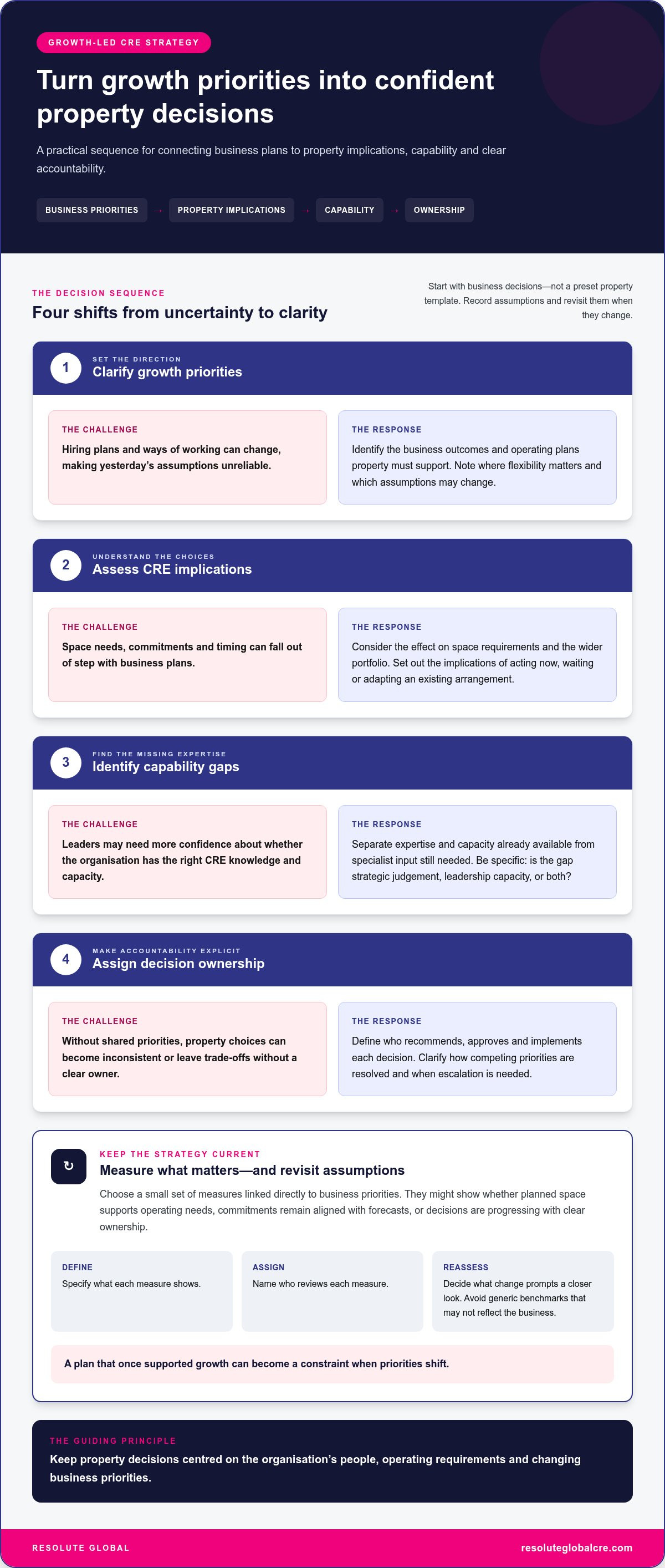
Build the strategy from business decisions, not from a preset property template. A practical sequence connects organisational priorities to property implications, highlights where expertise is needed and makes accountability explicit. Record the assumptions behind each decision, then revisit them when those assumptions change.
Clarify growth priorities.
Identify the business outcomes and operating plans property must support. Note where flexibility matters and which assumptions, such as hiring plans or ways of working, could change.
Assess CRE implications.
Consider how those priorities affect space requirements, commitments, timing and the portfolio as a whole. Set out the implications of acting now, waiting or adapting an existing arrangement.
Identify capability gaps.
Separate the knowledge and capacity already available from the specialist input needed to assess decisions confidently. Be specific about whether the gap is strategic judgement, leadership capacity or both.
Assign decision ownership.
Set out who recommends, approves and implements each decision, and how leaders resolve competing priorities. Make clear when a decision needs escalation.
Choose a small set of measures that connect directly to business priorities. Depending on the organisation’s goals, these might show whether planned space supports operating needs, whether commitments remain aligned with forecasts, or whether decisions are progressing with clear ownership. Define each measure, name who reviews it and decide what change would prompt a closer look. Avoid generic benchmarks that may not reflect the business.
Review CRE decisions against changing business needs. A plan that once supported growth can become a constraint when priorities shift.
Turn business priorities into CRE decisions and accountability
Senior leaders should agree which choices require CRE expertise, who has authority to make them and when escalation is needed. This creates a clear line from business priority to property decision, instead of leaving teams to interpret direction independently. Separate ongoing strategic oversight from periodic specialist capability: leadership keeps priorities and accountability connected, while specialist expertise can address needs that arise at particular stages.
For a CRE strategy for high growth companies, clarity is a practical control, not an administrative extra. Resolute Global provides occupier-focused Corporate Real Estate guidance to help leaders keep property decisions centred on organisational needs as they evolve.
When Fractional-CRE can support a high-growth strategy
Senior Corporate Real Estate expertise is valuable when decisions carry strategic weight, but the need for that leadership can vary over time. A permanent executive appointment can suit an organisation with a sustained, full-time CRE remit. When priorities are shifting or senior input is needed periodically, Fractional-CRE offers another route: leadership capacity that can adapt as the organisation’s requirements change. Consider the work to be done, how long the need is likely to last and what authority is required to move decisions forward.
A Fractional-CRE Executive is an embedded leader with defined authority, working within the organisation’s leadership structure rather than delivering isolated tasks. The executive can connect property decisions to business priorities, clarify responsibilities and provide senior judgement when needed. This gives organisations a flexible option without assuming that every company requires a permanent CRE leader.
What the Fractional-CRE Executive model makes possible
> 72 % of Fractional Executives have 15+ years of experience. That depth of experience can give mid-market and global organisations access to seasoned leadership while allowing support to respond to changing requirements. Fractional Executives can be engaged in a matter of hours, with engagements completed in two hours. This can bring senior expertise into a decision without building a permanent structure too soon.
Resolute Global’s Fractional-CRE platform connects organisations with a curated global community of former Corporate Real Estate Executives. It can support a CRE strategy for high growth companies that needs senior oversight or capability that changes with the business, rather than a fixed model.
To discuss how Fractional-CRE could fit your organisation’s priorities, contact Resolute Global at james.mclean@resoluteglobalcre.com or +44 7867 140785. Website: www.ResoluteGlobalCRE.com.
Make your next CRE decision growth-ready
The next step isn’t to predict every turn in the company’s growth. It is to build a CRE strategy for high growth companies that can be revisited as priorities develop. Set a clear point for leaders to reassess assumptions, capability and decision rights. That discipline keeps property choices purposeful without demanding certainty the business cannot yet have.
When senior CRE input is needed intermittently, Resolute Global’s Fractional-CRE platform offers access to a curated community of former Corporate Real Estate Executives, embedded leadership with defined authority and a global advisory network. The aim is to match experienced leadership to the organisation’s needs, not add structure for its own sake.
Identify the upcoming decision that would benefit most from experienced CRE perspective. Explore Resolute Global’s Fractional-CRE platform and take the next step towards clearer, growth-aligned property decisions.
Frequently Asked Questions
What is Gartner's forecast for fractional executives by 2027?
Gartner forecasts that by 2027, > 30 % of mid-size enterprises will have at least one fractional executive on retainer. This is a forecast, not a guarantee or a claim about every sector. It offers context for leadership planning. Each organisation should assess whether its capability needs are periodic or permanent, based on its priorities and upcoming decisions.
How much less can a Fractional Executive cost than a full-time C-suite hire?
Fractional Executives cost up to 60 % less than full-time C-suite hires: US$40k-US$120k annually versus US$200k-US$500k+ annually. These are stated annual ranges, not a quote for an individual engagement. For a useful comparison, consider the capability required, how long it is needed and the authority the role must hold.
How quickly can a Fractional-CRE Executive be engaged?
A Fractional Executive can be engaged in a matter of hours, with engagements completed in two hours. Traditional C-suite hiring takes 4-6 months. The engagement is shaped around the specific capability gap and the authority required to address it.
Is a Fractional-CRE Executive an embedded leader or an external adviser?
A Fractional-CRE Executive is an embedded leader with defined authority. The model provides senior-level expertise on flexible terms when an organisation needs particular capabilities periodically rather than permanently. Leaders can define the executive’s decision rights and responsibilities around a specific CRE priority, keeping the role connected to the organisation’s work and wider growth strategy.
Proudly Untraditional
We’re proudly untraditional in the way we think, operate, and deliver value in the Corporate Real Estate sector.
Whether you’re a client seeking a new experience or an independent real estate adviser please get in touch to learn more.
More from the field
Keep reading for more sharp analysis on global corporate real estate


