
Commercial Real Estate Conflict of Interest: Debunking 5 Myths in Corporate Property
If your property advisor is collecting fees from the person sitting across the negotiating table, whose interests are they actually protecting? You likely suspect that your lease terms are weighted in the landlord's favour, yet the industry insists that internal "Chinese walls" keep your data safe....


If your property advisor is collecting fees from the person sitting across the negotiating table, whose interests are they actually protecting? You likely suspect that your lease terms are weighted in the landlord's favour, yet the industry insists that internal "Chinese walls" keep your data safe. This systemic commercial real estate conflict of interest is the quiet drain on your corporate portfolio, often masked by complex fee structures and slow decision-making. It's time to demand transparency.
We understand the frustration of feeling like a secondary priority in your own transactions. This guide debunks five pervasive myths that keep occupiers tethered to compromised advice and reveals how to access senior-level, unbiased expertise without the cost of a full-time hire. We'll explore a new framework for independent representation that aligns with your business growth. Discover a more intelligent, streamlined way to lead your property strategy.
Key Takeaways
• Identify how dual agency creates a structural commercial real estate conflict of interest that fundamentally prioritises landlord returns over occupier savings.
• Uncover the reality of "Chinese walls" and why these internal barriers often fail to protect your sensitive strategic data from competing landlord teams.
• Explore the Fractional-CRE alternative to access elite, independent leadership that is entirely unburdened by traditional brokerage bureaucracy.
• Learn how to secure senior-level property guidance on demand, with engagements capable of starting in just two hours to address critical portfolio needs.
The Myth of the 'Full-Service' Broker: Why Dual Agency Creates a Commercial Real Estate Conflict of Interest
In the professional property world, a conflict of interest is any circumstance that impedes an individual's ability to act impartially whilst representing an occupier. This most frequently manifests as the "Dual Agency" trap. When a single brokerage represents both the landlord and the tenant, they create a structural bias that penalises the occupier. It's impossible to secure the lowest possible rent whilst also trying to achieve the highest possible return for a landlord client. This commercial real estate conflict of interest is often hidden behind the "Full-Service" label, but it fundamentally compromises your negotiating position.
Strategic Corporate Real Estate (CRE) leadership differs profoundly from a standard commercial transaction. One is a commoditised hunt for a signature. The other is a curated alignment with your business goals. Traditional firms often prioritise the former because their revenue structures demand volume over precision.
The Revenue Gap: Why Your Advisor Might Not Be on Your Side
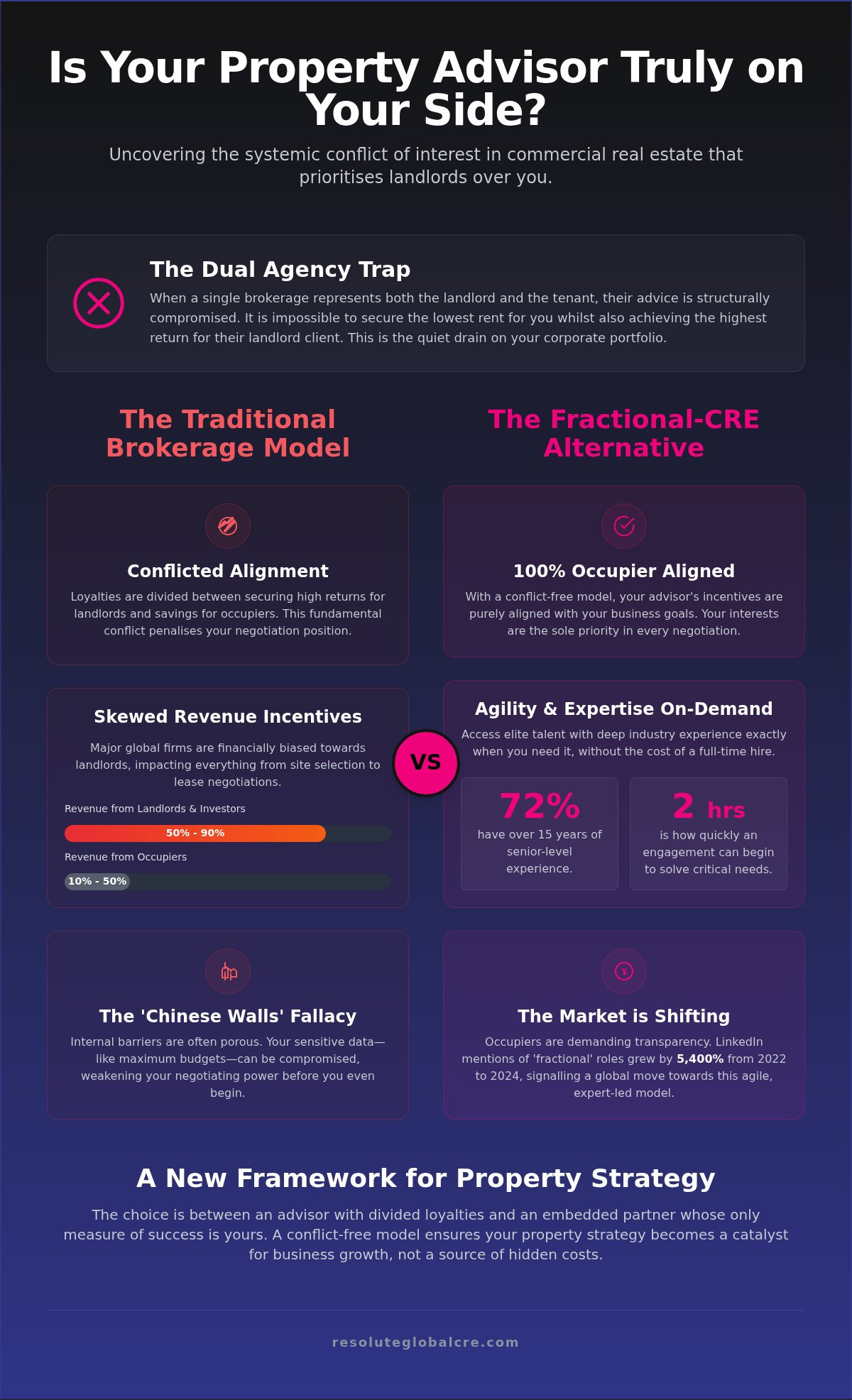
The incentives are obvious when you follow the money. Major global firms typically receive between 50% and 90% of their revenue from investors and landlords. This massive financial skew dictates their internal culture and performance metrics. This ingrained financial bias directly impacts lease negotiations and site selection, creating a commercial real estate conflict of interest by prioritising buildings where the firm already has a lucrative listing agreement. To be effective, occupier-focused guidance must be a core business model, not a secondary department. It requires an independent, principled approach that rejects landlord representation entirely.
The 'Chinese Walls' Fallacy: Why Large-Scale Firms Struggle to Protect Occupiers
The industry relies heavily on "Chinese Walls" to mitigate commercial real estate conflict of interest risks, but these internal barriers are often more theoretical than functional. They are frequently porous. When your advisor understands your maximum budget whilst their colleague in the next department manages the landlord's account, your negotiating power is structurally compromised. Information flows through social channels and shared databases. Traditional service partners often stifle growth by prioritising their own cross-selling opportunities over your operational agility. The 2024 Leadership Trends Study confirms this shift in sentiment, showing that senior executives are increasingly sceptical of the dual-agency promises made by large-scale institutions.
Why Disclosure Does Not Equal Protection
Legal compliance shouldn't be mistaken for genuine protection. Whilst firms are required to follow Federal regulations on conflicts of interest by disclosing dual representation, this procedural act doesn't erase the underlying financial motivation to favour a high-value landlord. A Fractional-CRE executive provides a level of embedded authority that external brokers simply cannot replicate. Contrast the arm's-length recommendation of a standard broker with the "embedded leader" status of an executive from Resolute Global. This model ensures your advisor is "on your side" of the table, not just a middleman managing two conflicting sets of books. You can secure this conflict-free real estate solution to ensure your interests remain the sole priority in every negotiation.
The Conflict-Free Alternative: The Rise of Fractional Corporate Real Estate
The industry is shifting. Traditional brokerage models are being bypassed in favour of the world’s first Fractional-CRE platform. This model provides elite, conflict-free talent without the burden of a permanent hire. It's a response to a global demand for transparency; LinkedIn mentions of ‘fractional’ roles grew by 5,400% between 2022 and 2024. By removing the structural commercial real estate conflict of interest, occupiers finally gain an advisor whose incentives are purely aligned with their own growth. This evolution ensures that your strategy remains unencumbered by the hidden agendas of traditional firms.
Accessing Elite Talent on Agile Terms
Speed is the new currency of property strategy. Engagements through this model can be completed in a matter of hours, with some starting in just two hours. This agility doesn't sacrifice quality. Over 72% of these Fractional Executives possess more than 15 years of experience, providing the deep "pattern recognition" that traditional brokers often lack. When Analyzing Potential Conflicts of Interest, it becomes clear that an embedded leader is more effective than an arm's-length consultant.
The cost efficiency is equally compelling. Fractional Executives typically cost between US$40,000 and US$120,000, representing a 60% saving compared to full-time C-suite hires who command US$200,000 to over US$500,000. This isn't just a niche trend. Gartner forecasts that by 2027, over 30% of mid-size enterprises will have at least one fractional executive on retainer. It's a strategic evolution for mid-market and global organisations seeking to eliminate any commercial real estate conflict of interest from their operations.
Securing Your Occupier Advantage through Conflict-Free Leadership
Relying on traditional brokerage models often means accepting a structural commercial real estate conflict of interest that favours the landlord. You've seen how internal information barriers fail and why simple disclosure doesn't equate to true protection for your sensitive data. Elite property strategy requires an embedded leader, not just an arm's-length transaction.
Modern organisations are now bypassing these legacy flaws by adopting a more surgical approach. By engaging a Fractional-CRE executive, you gain access to senior-level expertise where 72% of professionals have 15+ years of experience. This model costs up to 60% less than a permanent hire, with engagements starting in as little as two hours. Ready to secure conflict-free leadership? Contact James McLean at Resolute Global today to transform your portfolio strategy. It's time to work with an advisor who is definitively on your side.
Frequently Asked Questions
Is dual agency legal in commercial real estate transactions in the UK?
Dual agency remains legal in the UK, provided there is informed consent and strict adherence to RICS professional standards. However, legality doesn't equate to neutrality. Even with disclosure, a structural commercial real estate conflict of interest persists because the advisor’s firm often relies on landlords for recurring revenue. This creates an inherent bias that can subtly undermine an occupier's negotiating position.
How much can a business save by using a Fractional CRE Executive instead of a full-time hire?
Businesses typically achieve cost savings of up to 60% by opting for fractional leadership. A full-time C-suite hire in this field commands between US$200,000 and US$500,000+, whilst a Fractional Executive costs significantly less, ranging from US$40,000 to US$120,000. This model allows organisations to access elite, senior-level expertise on agile terms without the heavy financial burden of a permanent, high-tier salary and benefits package.
Can a Fractional CRE Executive really start working within a few hours?
Yes, our platform is built for immediate impact, with some engagements initiated in as little as two hours. This rapid deployment allows your business to respond to market shifts or critical lease events without the delays of traditional recruitment or the bureaucracy of global brokerage firms. It’s a surgical approach to property strategy, ensuring you have an expert on your side exactly when you need them.
What is the difference between a real estate consultant and a Fractional CRE Executive?
The distinction lies in the depth of integration. A traditional consultant provides arm's-length recommendations, whereas a Fractional Executive acts as an Embedded Leader within your organisation. They possess the "pattern recognition" from over 15 years of senior experience. Rather than just offering advice, they take ownership of your portfolio strategy, ensuring every decision is unencumbered by the external pressures that often drive standard brokerage behaviours.
How does Resolute Global ensure there are no landlord conflicts in their network?
We maintain a strict, principled stance by never representing landlords. This ensures 100% occupier-centric behaviour across our entire network. By selecting only former senior executives who've seen the flaws in the standard industry model, we eliminate the risk of a commercial real estate conflict of interest. Our curators prioritise integrity over volume, providing a bespoke, unconflicted alternative to the "full-service" firms that serve both sides.
What happens if our Corporate Real Estate needs change during a fractional engagement?
Agility is a core pillar of our methodology. If your requirements shift, you can adjust the scope of the engagement or the hours required without the friction of rigid, long-term contracts. This flexibility is essential for businesses navigating rapid growth or market volatility. You retain access to elite expertise on your own terms, ensuring your property strategy remains perfectly aligned with your evolving commercial objectives.
Proudly Untraditional
We’re proudly untraditional in the way we think, operate, and deliver value in the Corporate Real Estate sector.
Whether you’re a client seeking a new experience or an independent real estate adviser please get in touch to learn more.
More from the field
Keep reading for more sharp analysis on global corporate real estate