
Cost-effective real estate expertise: a smarter CRE model
What if the most cost-effective way to close a Corporate Real Estate capability gap isn’t another permanent hire? Cost-effective real estate expertise isn’t simply about paying less. It’s about matching senior leadership to the decisions, risks and growth priorities your organisation actually has. W...


What if the most cost-effective way to close a Corporate Real Estate capability gap isn’t another permanent hire? Cost-effective real estate expertise isn’t simply about paying less. It’s about matching senior leadership to the decisions, risks and growth priorities your organisation actually has.
When expertise is missing, property decisions can slow down, while a full-time senior role may provide more capacity than the business needs. Generic advice can also leave accountability unclear. The answer isn’t less expertise, but a more considered way to access it.
This article explains how to assess strategic value beyond short-term savings, when fractional CRE leadership may fit better than a permanent appointment, and how embedded senior leaders with defined authority can help close a capability gap. You’ll also find practical criteria for deciding whether your need is periodic or ongoing.
Key Takeaways
• Assess cost-effective real estate expertise by how well senior capability and engagement flexibility match your business need, not simply by the lowest immediate cost.
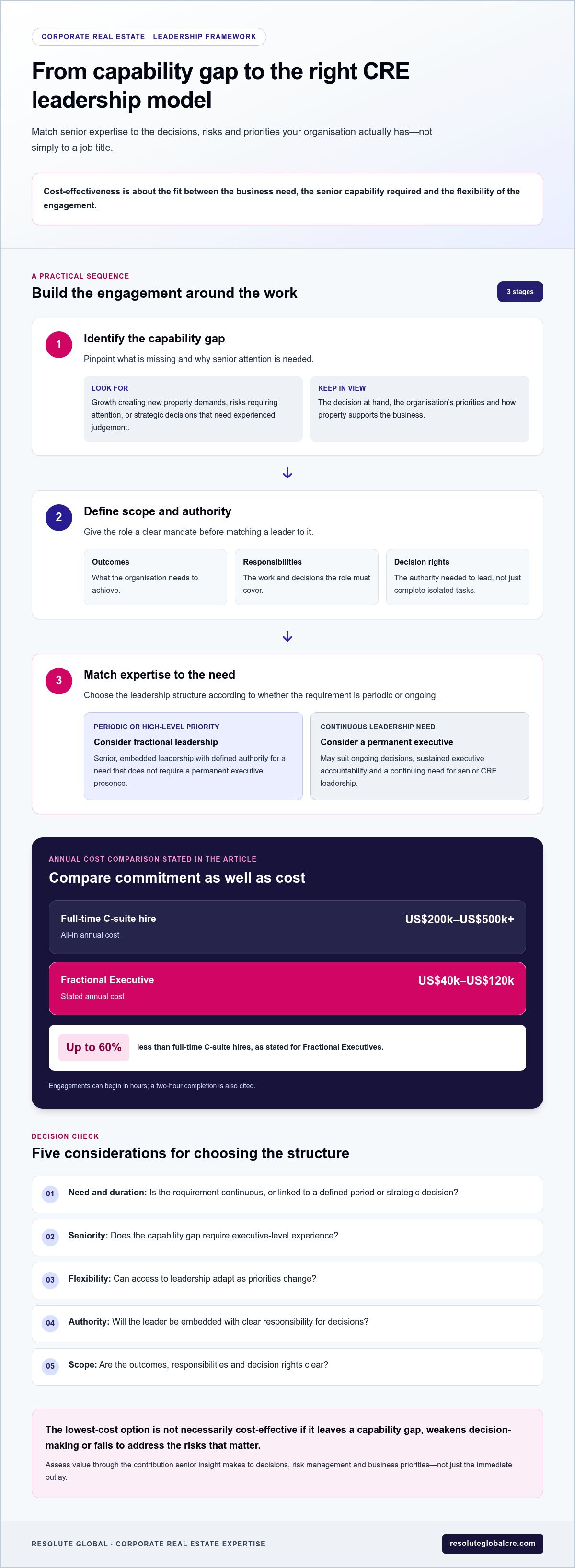
• Compare the commitment and authority required: the stated annual ranges are US$200k-US$500k+ for a full-time C-suite hire and US$40k-US$120k for a Fractional Executive.
• Identify the capability gap, define the scope and decision-making authority, then match expertise to whether your need is periodic or ongoing.
• Explore how Resolute Global’s Fractional-CRE platform, Fractional-CRE Executive model and curated global community connect organisations with senior Corporate Real Estate expertise.
What makes real estate expertise cost-effective for corporate occupiers?
Cost-effective real estate expertise is the right fit between a business need, the senior capability required to address it and the flexibility of the engagement. A capability gap can slow decisions about a workplace, lease commitment or portfolio direction. The answer isn’t automatically a permanent appointment or the cheapest available advice. It’s expertise that matches the scale and importance of the decision.
Cost versus value in Corporate Real Estate
Expenditure is the immediate outlay for expertise. Value is the contribution relevant senior insight makes to decisions, risk management and business priorities.
For corporate occupiers, assess value in the context of the decision at hand. Identify the capability that is missing, the risks that need attention and how the property decision supports the organisation. A broad reference to property categories is available in the Commercial Property Overview, but Corporate Real Estate decisions focus on how an organisation occupies and uses space, rather than residential property sales.
The lowest-cost option is not necessarily cost-effective if it leaves a capability gap, weakens decision-making or fails to address the risks that matter.
Occupier-focused guidance starts with the organisation’s priorities, whether that means aligning space with business needs, weighing a property decision or improving oversight of a portfolio. Conflict-free advice keeps those priorities central and gives leaders a clearer basis for decisions, grounded in how the organisation operates.
Flexibility matters too. If senior expertise is needed for a defined period or a high-level decision, access on terms suited to that need can be more proportionate than maintaining a permanent role. Consider not just the cost, but whether the right capability will be available when it can make a difference.
How to compare fractional CRE expertise with a full-time hire
Choose the structure around the work, not the job title. A permanent executive may suit an organisation with a continuous need for senior Corporate Real Estate leadership, ongoing decisions and sustained executive accountability. Fractional leadership can fit a periodic or high-level priority that still calls for experienced judgement and authority to lead.
Compare the options against these practical considerations:
Need and duration
Is the requirement continuous, or linked to a defined period or strategic decision?
Seniority
Does the gap require executive-level experience?
Flexibility
Can access to leadership adapt as priorities change?
Authority
Will the leader be embedded with clear responsibility for decisions, rather than asked to complete isolated tasks?
Scope
Can you describe the outcomes, responsibilities and decision rights the role needs to cover?
The stated annual cost ranges are US$200k-US$500k+ for a full-time C-suite hire, all-in, and US$40k-US$120k for a Fractional Executive. Fractional Executives cost up to 60 % less than full-time C-suite hires. Engagements can begin in hours, with engagements completed in two hours cited. The GAO Report on Effective Asset Management offers a perspective on managing property assets efficiently, although it addresses US federal agencies rather than UK organisations.
When does a fractional executive model fit?
Consider fractional leadership when you need senior direction for a periodic, high-level requirement rather than a permanent executive presence. Fractional Executives are embedded leaders with defined authority, not task-based support. Clarify decision rights and responsibilities from the outset so the role has a clear mandate.
The stated comparison is US$40k-US$120k annually for a Fractional Executive versus US$200k-US$500k+ for a full-time C-suite hire. Fractional Executives can cost up to 60 % less, and engagements can begin in hours, with a two-hour completion cited. Occupier-focused CRE guidance can help frame the leadership structure around your organisation’s needs.
How Resolute Global makes cost-effective CRE expertise actionable
Turning a capability gap into the right leadership structure starts with three questions: What does the organisation need to achieve? What authority will the role require? Is the capability needed periodically or on a continuing basis? Answering these keeps the focus on business priorities, not simply filling a vacancy.
From capability gap to an agile CRE engagement
Identify the gap
Is growth creating new property demands? Are there risks or strategic decisions that need senior attention?
Define scope and authority
Set out the outcomes, responsibilities and decision-making authority required, so the leader is embedded with a clear mandate.
Match expertise to need
Decide whether the capability is required periodically or permanently, then align the leadership model accordingly.
Flexible senior expertise works best when it is matched to a clearly defined business need and given the authority to address it.
Resolute Global’s Fractional-CRE platform and Fractional-CRE Executive model give mid-market and global organisations access to senior Corporate Real Estate expertise on flexible terms. The model is designed for periodic, high-level needs rather than permanent hires. It draws on a curated global community of former Corporate Real Estate Executives, supported by an occupier-focused approach and a global advisory network.
To make cost-effective real estate expertise actionable, define the capability you need, the decisions it must support and whether a flexible senior leader fits the requirement. Resolute Global’s approach connects those priorities with fractional CRE leadership.
Visit www.ResoluteGlobalCRE.com, email james.mclean@resoluteglobalcre.com or call +44 7867 140785.
Put the right CRE leadership within reach
Cost-effective real estate expertise means matching senior capability to the decisions your organisation needs to make, rather than defaulting to a permanent hire or choosing on cost alone. Fractional leadership can suit periodic, high-level requirements, with embedded authority and flexibility aligned to business priorities.
Fractional Executives cost up to 60 % less than full-time C-suite hires, and engagements can begin in hours, with a two-hour engagement cited. The value comes from bringing the right expertise to a clearly defined need, with the pace and scope your organisation requires.
Explore Resolute Global’s Fractional-CRE expertise, or contact James McLean at james.mclean@resoluteglobalcre.com or +44 7867 140785 to discuss your Corporate Real Estate priorities.
Frequently Asked Questions
What does cost-effective real estate expertise mean for a business?
Cost-effective real estate expertise means matching the level of senior Corporate Real Estate capability to your organisation’s needs, including how often that expertise is required. It’s not simply about choosing the lowest outlay. Consider whether the leadership can support important property decisions, address capability gaps and help manage risk, with clear scope and authority suited to your business priorities.
How much does a Fractional Executive cost compared with a full-time C-suite hire?
The stated annual cost range for a full-time C-suite hire is US$200k-US$500k+ (all-in), compared with US$40k-US$120k for a Fractional Executive. The stated comparison is that Fractional Executives cost up to 60 % less than full-time C-suite hires. Consider these figures alongside the seniority, duration and authority your organisation requires.
How quickly can a Fractional-CRE Executive start?
A Fractional-CRE Executive can be engaged in hours, with engagements completed in two hours cited. This speed can help an organisation address a pressing capability gap without waiting for a permanent hire. The timing is a cited example, not a guarantee for every situation. Define the need, scope and decision-making authority so the engagement is aligned with the work required.
Are Fractional Executives consultants or contractors?
No. Fractional Executives are embedded leaders with defined authority, rather than consultants or task-based contractors brought in to deliver isolated assignments. They provide senior expertise within the organisation’s leadership context, with responsibilities shaped around its business need. This distinction matters: the model is intended to address periodic, high-level requirements while maintaining clear accountability for the work and decisions in scope.
Proudly Untraditional
We’re proudly untraditional in the way we think, operate, and deliver value in the Corporate Real Estate sector.
Whether you’re a client seeking a new experience or an independent real estate adviser please get in touch to learn more.
More from the field
Keep reading for more sharp analysis on global corporate real estate