
Office Space Relocation Strategy UK: A Business-Led Guide
What if the biggest risk in an office move is choosing a property before deciding what the business needs from it? An occupier-led Office space relocation strategy UK organisations can put to work starts with workplace requirements, operational priorities and continuity, not a shortlist of buildings...


What if the biggest risk in an office move is choosing a property before deciding what the business needs from it? An occupier-led Office space relocation strategy UK organisations can put to work starts with workplace requirements, operational priorities and continuity, not a shortlist of buildings.
It’s understandable to be unsure where to begin. Property decisions made too early can constrain future ways of working, whilst rushed planning can put people and essential operations under pressure. A clear sequence helps: let business objectives guide each decision.
This guide explains how to define occupier requirements, connect property choices with future workplace needs, and organise responsibilities and move planning around business continuity. It also considers how flexible senior CRE leadership, embedded with defined authority, can support organisations that need experienced guidance without a permanent hire. Start with the business, then plan the move.
Key Takeaways
• Build your Office space relocation strategy UK around business objectives and occupier outcomes before assessing property options.
• Set a clear decision sequence, assign owners and connect workplace requirements with people, technology and business continuity planning.
• Use defined criteria for the operating model, workforce needs and portfolio priorities to assess whether premises can support future needs.
• Consider embedded senior CRE leadership for periodic capability gaps: > 72% of Fractional Executives have 15+ years of experience, and engagements can be completed in hours, with two hours cited.
Office space relocation strategy UK: start with business needs, not listings
A practical Office space relocation strategy UK organisations can use starts with the business case, not a property search. Define why a move is being considered, what needs to improve and what staying would mean. The case might involve supporting a changed operating model, responding to workforce needs or aligning premises with wider portfolio priorities. Without a clear mandate, attractive listings can draw attention to features that matter less than the organisation’s requirements.
Set criteria that connect property decisions to business outcomes: how work is done, who needs to use the workplace and how the premises fit the portfolio. Include continuity from the outset. Identify which operations must remain available during the transition and what the workplace needs to support. These are connected questions, not separate property and workplace exercises. A relocation strategy is a business-led plan for aligning property, people and operations around the outcomes an organisation needs. The linked office space planning principles offer useful context on how workplace design relates to occupants and business needs.
What should an office relocation strategy establish first?
Make the mandate clear before comparing workplaces. Record the reason to move, the intended outcomes and the implications of staying. Name an executive sponsor, internal decision-makers and the teams affected, so ownership is clear from the outset. Then separate essential requirements from preferences. This gives the organisation a consistent basis for weighing options rather than allowing individual preferences to dominate.
Operating model
Identify the work patterns and functions the space must support.
Workforce needs
Consider who uses the workplace, how they collaborate and what access they require.
Portfolio priorities
Assess how a move fits the organisation’s wider property direction.
Business continuity
Define the operations that must keep running through the transition.
Use these criteria as a decision filter. If a potential workplace does not meet an essential requirement, attractive features should not obscure the gap. Record the shortfall and decide whether it can be resolved before progressing. That discipline keeps the relocation occupier-led from the first brief onwards.
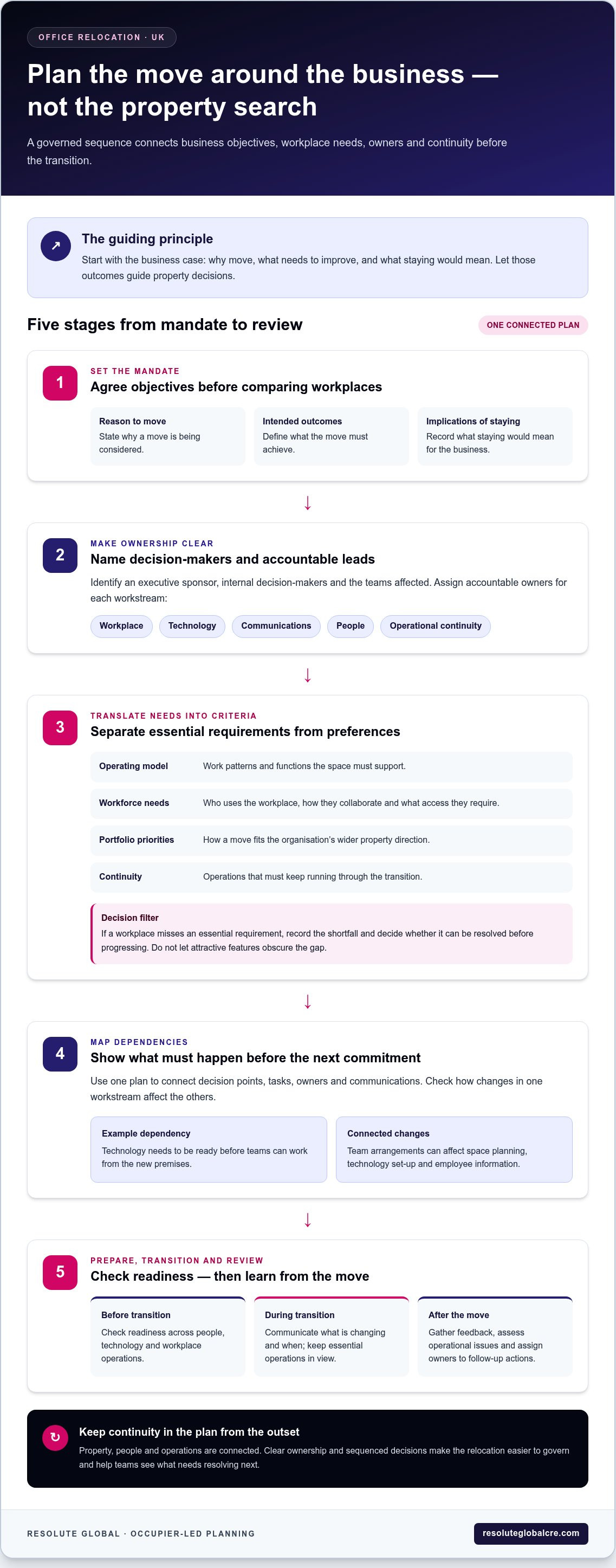
How to plan an office relocation in the UK without losing sight of operations
Turn the relocation mandate into a governed plan, with decisions in the right order and named owners for each workstream. An Office space relocation strategy UK organisations can use should connect property milestones to the practical changes people and operations will experience. Treating the move as a standalone logistics exercise risks overlooking those dependencies.
Agree objectives
Confirm what the move must achieve and how proposals will be assessed against those outcomes.
Assign owners
Give accountable leads responsibility for workplace, technology, communications, people and operational continuity.
Assess requirements
Translate agreed needs into clear workplace, systems and support requirements.
Plan dependencies
Map which decisions and tasks rely on others, such as technology readiness before teams can work from the new premises.
Prepare the transition
Set readiness checks, communicate what is changing and when, and plan how to review the move once teams are operating in the new space.
These workstreams affect one another. A change to team arrangements, for example, may affect space planning, technology set-up and the information employees need. Staff relocation support may also be relevant. The UK government guidance on relocation payments explains qualification for relocation expenses.
How can teams sequence relocation decisions and manage disruption?
Use one plan to show decision points, dependencies, owners and communications. This lets teams see what needs resolving before the organisation makes its next commitment. Before the transition, review readiness across people, technology and workplace operations. After the move, gather feedback and assess operational issues, then assign owners to actions that need follow-up. Clear ownership and sequenced decisions make relocation planning easier to govern.
Where senior CRE capacity would strengthen oversight, explore occupier-focused CRE guidance as part of the planning approach.
When an office move needs senior CRE leadership, consider flexible occupier-side support
A relocation can create a need for senior Corporate Real Estate expertise. Complex property decisions, competing internal priorities and operational dependencies may stretch an existing team, even when the requirement is linked to a particular business initiative rather than a permanent executive role. An Office space relocation strategy UK organisations can govern effectively needs clear occupier-side oversight, with authority to connect property decisions to the organisation’s interests.
Resolute Global’s Fractional-CRE Executive model provides flexible access to former Corporate Real Estate Executives as embedded leaders with defined authority. > 72% of Fractional Executives have 15+ years of experience. The annual cost range for Fractional Executives is US$40k-US$120k, compared with US$200k-US$500k+ for full-time C-suite hires. These figures can help business leaders weigh flexible senior capability against a permanent appointment, based on the organisation’s needs.
How does the Fractional-CRE Executive model relate to relocation?
An embedded leader can help maintain a strategic view across property choices, occupier requirements and relocation decisions, with defined authority within the organisation. This is senior leadership integrated with the organisation’s needs, rather than task-based support. Engagements can be completed in hours, with two hours cited, which may help when a capability gap needs to be addressed quickly.
Consider this approach when a relocation calls for experienced CRE leadership but the organisation’s need is periodic or tied to a specific business initiative. To discuss occupier-focused support for your relocation, contact Resolute Global at www.ResoluteGlobalCRE.com, james.mclean@resoluteglobalcre.com or +44 7867 140785.
Put your relocation mandate into motion
Turn your Office space relocation strategy UK into a clear brief for executive decision-makers: what the move must enable, who will govern it and where senior CRE input is needed. A focused mandate gives the organisation a stronger basis for decisions as the project advances.
Where additional leadership is useful, Resolute Global’s Fractional-CRE Executive model provides embedded leadership with defined authority. Engagements can be completed in hours, with two hours cited. Set out the decisions and responsibilities that need senior CRE oversight as part of the relocation brief.
Discuss occupier-focused CRE support with Resolute Global, or contact the team at www.ResoluteGlobalCRE.com, james.mclean@resoluteglobalcre.com or +44 7867 140785. With the right mandate and leadership in place, you can move forward with greater clarity.
Frequently Asked Questions
When should a business start planning an office relocation?
Start when the organisation has identified a business reason to move or needs to assess whether staying remains the right option. First establish the decision process, lease milestones and internal responsibilities. Then work backwards from the intended transition to map property decisions, technology readiness, communications and operational dependencies. The plan should reflect the organisation’s requirements rather than rely on a generic timetable.
How can a business decide whether to relocate or stay in its current office?
Compare staying and moving against the same business criteria. An Office space relocation strategy UK organisations can use should assess how well the current premises support present and anticipated work, what changes staying would require, and how a move would affect operations. Record the trade-offs, including constraints that cannot be resolved in the existing space, before making a recommendation.
How should hybrid working affect an office relocation strategy?
Base workplace requirements on how teams use the office, not simply on total headcount. Review attendance patterns, team schedules and the activities employees come in to do, such as collaboration or focused work. Then assess whether the proposed space can support those needs during busier periods as well as quieter ones. Hybrid arrangements should inform the brief, not dictate it.
Can a business access senior CRE expertise without making a permanent hire?
Yes. Fractional-CRE provides an organisation with flexible access to senior Corporate Real Estate expertise without a permanent executive appointment. In Resolute Global’s Fractional-CRE Executive model, former executives work as embedded leaders with defined authority. This can suit organisations that need experienced oversight for a relocation or another periodic CRE requirement, whilst keeping leadership aligned with the occupier’s interests.
Proudly Untraditional
We’re proudly untraditional in the way we think, operate, and deliver value in the Corporate Real Estate sector.
Whether you’re a client seeking a new experience or an independent real estate adviser please get in touch to learn more.
More from the field
Keep reading for more sharp analysis on global corporate real estate