
Why Occupier Real Estate Strategy is the New Business Driver in 2026
In 2026, the greatest threat to your corporate balance sheet isn't market volatility; it's a property strategy designed to serve landlords rather than your own commercial growth. Most executives have grown accustomed to the hidden costs of dual-agency negotiations and the rigidity of traditional lea...


In 2026, the greatest threat to your corporate balance sheet isn't market volatility; it's a property strategy designed to serve landlords rather than your own commercial growth. Most executives have grown accustomed to the hidden costs of dual-agency negotiations and the rigidity of traditional leases that stifle innovation. You've likely felt the frustration of being locked into long-term commitments whilst your business needs evolve at a much faster pace. It's a common struggle in an industry that often prioritises volume over bespoke value. Adopting a sophisticated occupier real estate strategy is the definitive way to break this cycle.
This article reveals how a conflict-free, occupier-centric approach transforms property from a burdensome fixed cost into a dynamic engine for agility, scale, and capital efficiency. We'll explore how you can secure a roadmap that eliminates conflicts of interest and leverages elite, fractional CRE leadership to optimise your portfolio. By the end, you'll understand how to reclaim control over your operational expenditure and align your physical footprint with a high-growth future.
Key Takeaways
• Transition from passive leasing to a proactive occupier real estate strategy that aligns your physical footprint with core commercial objectives for 2026.
• Recognise why conflict-free representation is a non-negotiable requirement for ensuring your advisor's loyalty remains entirely with the tenant.
• Master the art of Portfolio Optimisation to drive capital efficiency, mitigate IFRS 16 pressures, and turn real estate into a high-performing asset.
• Leverage the Fractional CRE model to inject senior-level property expertise into your business exactly when it is needed, avoiding unnecessary headcount costs.
• Gain a competitive edge by utilising a global advisory network that offers expansive reach delivered through a single, streamlined point of access.
Defining the Modern Occupier Real Estate Strategy
The era of viewing office space as a static overhead is over. For modern enterprises, an occupier real estate strategy is no longer a peripheral facility management task; it's the deliberate alignment of every square foot with the company's overarching commercial mission. By 2026, the global marketplace demands a shift from passive leasing, where decisions are reactive and isolated, to active strategic mandates. This approach ensures that property isn't just where you work, but how you grow. It's about moving from a position of being a tenant to being a strategic asset holder.
The traditional 'find-a-space' model is fundamentally broken. It relies on transactional speed rather than long-term value, often resulting in bloated portfolios and inflexible terms that hinder business velocity. Modern strategy requires a sophisticated global-local duality. This means maintaining a unified, high-level vision across an international portfolio whilst executing with surgical precision in local markets. It's a curated approach that prioritises business agility over simple square footage.
Why Real Estate is Now a Board-Level Priority
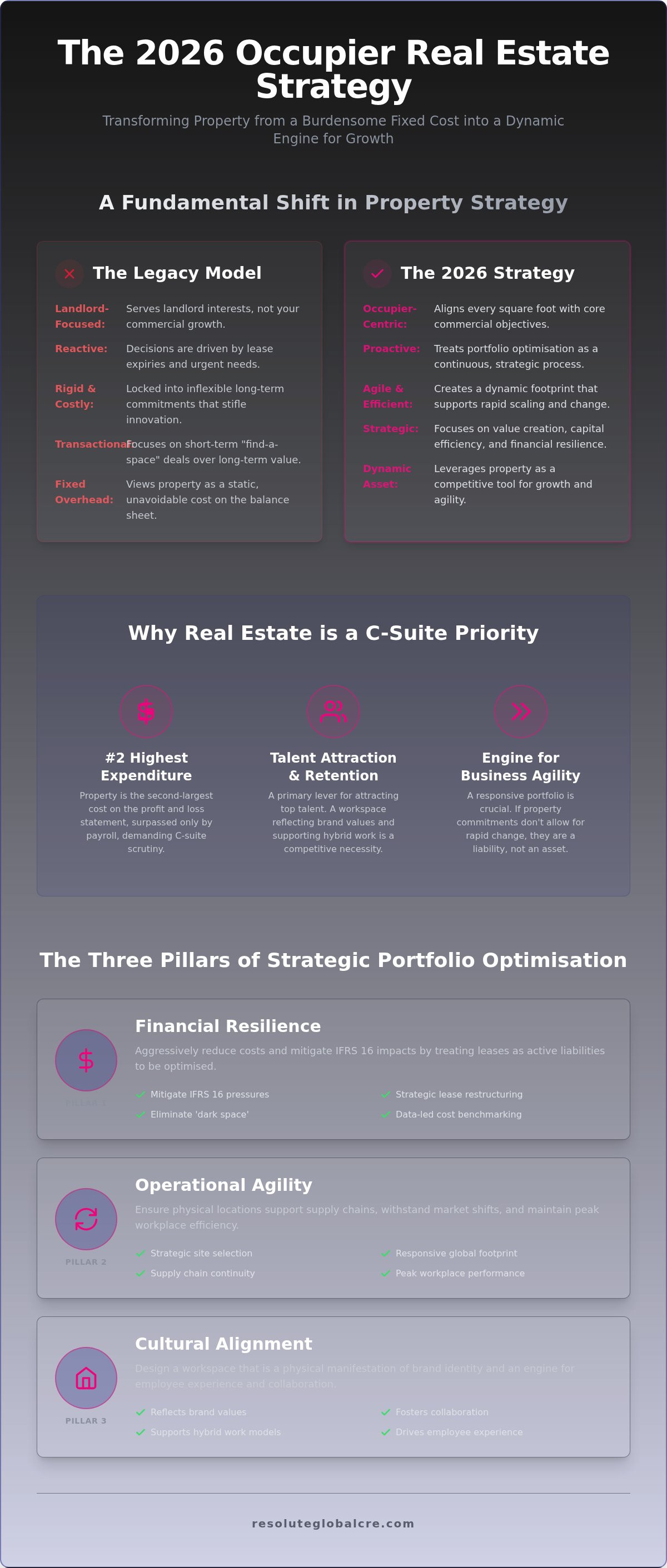
Property typically represents the second-highest expenditure on a firm's profit and loss statement, surpassed only by payroll. Because of this, C-suite leaders are scrutinising footprints with renewed intensity. Beyond the balance sheet, the physical environment is a primary lever for talent attraction and retention. A workspace that reflects brand values and supports hybrid workflows isn't a luxury; it's a competitive necessity. Agility is the other side of this coin. Your ability to scale or pivot operations quickly depends on having a portfolio that is responsive rather than restrictive. If your property commitments don't allow for rapid change, they are a liability, not an asset.
The Shift from Transactional to Strategic Thinking
Waiting for a lease expiry to trigger a conversation is a legacy behaviour that costs businesses millions in lost opportunities. Strategic thinking moves beyond the calendar, treating portfolio optimisation as a continuous, proactive process. This evolution also integrates Environmental, Social, and Governance (ESG) commitments directly into the occupier mandate. Sustainability is no longer a bolt-on. It's a core requirement for modern compliance, investor relations, and brand integrity. By 2026, the most successful firms will be those that view their real estate through a lens of value creation rather than cost containment.
An effective Occupier Strategy acts as a sophisticated tool for financial resilience by transforming rigid liabilities into flexible, growth-oriented assets.
The Three Pillars of Strategic Portfolio Optimisation
Portfolio Optimisation is not a static checkbox on a yearly audit; it's a continuous, high-stakes process of refinement. To build a resilient occupier real estate strategy, firms must balance three distinct yet interconnected pillars. These foundations ensure that every property commitment serves the bottom line, the daily operation, and the corporate soul. Ignoring any single pillar creates a structural weakness that market volatility will eventually exploit.
The Financial Pillar focuses on aggressive cost reduction and the mitigation of IFRS 16 impacts. By treating leases as active liabilities rather than "set and forget" contracts, businesses can free up capital for core growth. The Operational Pillar addresses site selection and supply chain continuity. It ensures that your physical locations are positioned to withstand market shifts whilst maintaining peak workplace efficiency. Finally, the Cultural Pillar recognises that a workspace is a physical manifestation of brand identity. It's the engine room for employee experience, designed to foster collaboration and belonging in a hybrid world.
Financial Resilience and Lease Restructuring
Underutilised assets, often termed 'dark space', represent a silent drain on UK corporate reserves. Identifying these inefficiencies requires more than a cursory glance at occupancy rates. It demands data-led benchmarking to compare your spend against national and international standards. Tactical lease renewals often fail because they focus on short-term rent holidays. In contrast, strategic restructuring looks at the entire portfolio to negotiate terms that reflect your 2026 requirements. If you want to move beyond basic cost-cutting, exploring occupier-focused CRE guidance provides the clarity needed to execute these complex financial manoeuvres.
Operational Agility in a Global Market
Modern businesses are increasingly adopting a hub-and-spoke model to balance a central presence with regional accessibility. This strategy relies on site selection powered by predictive labour analytics rather than just local availability. By understanding where your talent lives and how your supply chain flows, you can position your 'spokes' to maximise productivity and minimise commute times. Leveraging a global advisory network ensures this level of precision is maintained across borders. It provides consistent service delivery whether you're expanding into a new continent or consolidating local operations. Success in 2026 requires this blend of global reach and surgical local execution.
Navigating Conflicts: The Case for Independent Tenant Representation
Integrity remains the most critical component of a robust occupier real estate strategy. Unfortunately, this integrity is frequently compromised by the industry's reliance on 'Dual Agency'. This occurs when a single firm represents both the landlord and the tenant in the same market, or even within the same transaction. For the occupier, this creates a fundamental disadvantage. Your advisor's parent company may be collecting significant fees from the very landlord you are negotiating against. This isn't just an ethical grey area; it's a structural flaw that leads to inflated rents and restrictive lease terms. Choosing an independent, conflict-free partner is a fiduciary necessity for modern corporations that value transparency and fiscal discipline.
Traditional brokers often prioritise landlord relationships because they provide a steady stream of bulk revenue. For these firms, the tenant is often a one-off transaction, whilst the landlord is a career-long client. This dynamic naturally skews the advice you receive, often leading to 'market standard' deals that favour the property owner. Independent advisory flips this script. It ensures that every recommendation is filtered through the lens of your specific business needs, unburdened by the need to protect a landlord's portfolio value.
The Myth of the 'One-Stop Shop' Broker
Firewalls are often a corporate fiction. Large global firms point to internal barriers as a solution to dual-agency conflicts, but these are often insufficient to protect your interests. The psychological bias of an organisation that relies on landlord instructions for its primary revenue is hard to erase. Independent specialists leverage the same elite market data and global networks as the giants, but they do so without the baggage of conflicting loyalties. This independence allows for a more surgical approach to portfolio management, ensuring your occupier real estate strategy isn't diluted by competing interests.
Conflict-Free Lease Negotiation as a Tactical Advantage
True market transparency is only possible when your advisor has no reason to hide the truth. During rent reviews and renewals, a conflict-free representative will uncover landlord incentives that a conflicted broker might overlook. These can include:
Capital Contributions
Securing funding for fit-outs that landlords might otherwise keep quiet.
Extended Rent-Free Periods
Pushing for the maximum possible holiday based on real-time market data.
Clause Optimisation
Ensuring break options and reinstatement obligations serve your long-term agility.
This tactical advantage allows you to secure terms that aren't just competitive; they're specifically designed to support a nimble, growth-oriented operation. By removing the landlord's influence from the negotiation table, you regain control over your property's financial and operational future.
Agile Execution: Fractional CRE and Global Advisory Networks
Executing a sophisticated occupier real estate strategy requires more than just a vision; it demands high-tier expertise that is often too costly to maintain as a permanent overhead. Traditional corporate structures often struggle with the weight of full-time real estate departments that lack the agility to scale alongside the business. Fractional Corporate Real Estate (CRE) has emerged as the elite alternative for firms that require C-suite property leadership without the rigid commitment of a senior hire. This model provides immediate access to seasoned specialists who operate as an extension of your leadership team, delivering surgical precision to complex portfolio decisions.
The beauty of this approach lies in its responsiveness. Specialist networks are unencumbered by the internal bureaucracy that slows down larger institutions. By utilising a nimble, external mandate, businesses can pivot their property assets with the same speed they apply to their core commercial operations. It's about having the right expertise at the right time, ensuring that your real estate remains a tool for growth rather than a stagnant cost centre.
The Rise of the Fractional Head of Real Estate
Scaling senior property expertise up or down based on specific project requirements is a hallmark of modern financial discipline. A Fractional Head of Real Estate provides the same strategic oversight as a full-time executive but operates on a flexible, as-needed basis. This avoids the significant overhead of a permanent high-level salary whilst ensuring your occupier real estate strategy is guided by an industry veteran. These fractional services bring a vital outside-in perspective to internal teams, challenging legacy thinking and injecting fresh, market-tested methodologies into your property planning. It's a curated experience designed for businesses that value intelligence over headcount.
Leveraging a Global Advisory Network
Managing a portfolio across multiple territories often leads to fragmented service and inconsistent standards. A global advisory network solves this by providing a massive international reach through a single, simplified point of access. This ensures that the same high standards of representation are maintained in every market, regardless of geography. Local market intelligence is filtered through a global strategic lens, providing a coherent narrative across your entire footprint. This removes the friction of managing dozens of regional brokers, each with their own agendas. If you are ready to streamline your operations, you can access fractional CRE and global advisory services to secure a more intelligent way of working.
Elevating Your Strategy with Resolute Global
Resolute Global stands as the Strategic Global Specialist for organisations that have outgrown the limitations of traditional, rigid brokerage models. We recognise that a successful occupier real estate strategy isn't built on sheer volume; it's built on precision, independence, and a relentless focus on the tenant's advantage. Whilst larger institutions are often encumbered by their own internal structures and landlord dependencies, we offer a nimble, bespoke alternative. We provide the global reach of a giant delivered with the surgical focus of a boutique firm. It is a more intelligent, streamlined way of operating.
Our Occupier-Centric Philosophy
Our mandate is clear: we exclusively represent tenants. This conflict-free approach is the non-negotiable foundation of our fiduciary duty to you. By removing landlord representation from our business model, we ensure that our advice is entirely unbiased and focused on high-tier quality. The 'Resolute' approach is principled, independent, and highly selective. We don't aim to be everything to everyone. Instead, we connect our clients with a worldwide network of elite professionals who share our commitment to excellence and transparency. This global advisory network ensures you receive the same level of senior expertise in any international market as you do in your home territory.
Our methodology rejects the cold, impersonal corporate-speak of traditional institutions. We prefer a voice that is intentional and highly focused on the client’s advantage. This means delivering actionable insights that directly impact your P&L, rather than vague reports that lack commercial bite. We treat your real estate as a dynamic tool for scalability and cost-efficiency. It's a curated experience designed for businesses that value intelligence over headcount.
Ready to Organise Your Global Footprint?
Transforming your property from a fixed liability into a strategic engine for growth starts with a clear-eyed assessment of your current assets. Whether you require a comprehensive portfolio audit to identify 'dark space' or a long-term fractional CRE engagement to guide your C-suite, we provide a single, simplified point of access for all your global property needs. We eliminate the friction of managing disparate regional brokers and replace it with a unified, strategic mandate. This ensures your occupier real estate strategy is consistent, efficient, and unburdened by local conflicts.
The benefit of this model is immediate agility. You gain the ability to scale your senior property expertise up or down based on your actual project requirements, avoiding the unnecessary overhead of permanent hires. It's about moving from fixed property costs to a strategic advantage. It's about choosing a partner who is genuinely on your side. Discover how Resolute Global can transform your occupier strategy.
Reclaiming the Commercial Edge through Strategic Property
Real estate is no longer a static line item on your balance sheet; it's a strategic lever for growth and resilience. By 2026, the most successful firms will be those that have abandoned the inherent conflicts of dual agency in favour of a transparent, occupier real estate strategy. This shift ensures that every square foot is an active contributor to your commercial success rather than a passive drain on capital. You don't need the overhead of a massive internal department to achieve this level of sophistication.
Accessing an Independent Global Advisory Network and leveraging Fractional CRE Expertise allows you to scale with surgical precision. It's about being nimble, unencumbered, and profoundly focused on your own advantage. By choosing 100% Conflict-free Tenant Representation, you reclaim control over your operational expenditure and align your physical footprint with your long-term mission. It is a more intelligent way to operate in an increasingly complex global market.
Partner with Resolute Global for conflict-free, elite property advisory.
The future of your portfolio belongs to those who act with intention and clarity. Secure your competitive advantage today.
Frequently Asked Questions
What is an occupier real estate strategy and why does my business need one?
An occupier real estate strategy is the intentional alignment of your property portfolio with your overarching commercial objectives. It moves beyond simple leasing to treat space as a tool for financial resilience and business agility. You need this approach to ensure your second largest P&L expense supports your growth rather than hindering it. By prioritising the tenant's needs, you turn static overheads into dynamic assets that facilitate scaling and rapid market pivots.
How does conflict-free tenant representation differ from traditional brokerage?
Conflict-free representation ensures your advisor's loyalty is focused entirely on your interests as a tenant. Traditional brokerage firms often represent both landlords and occupiers, creating a fundamental conflict of interest where your advisor might be profit-sharing with your landlord. A conflict-free specialist eliminates these ethical grey areas. This independence allows for more aggressive negotiations and secures terms that truly serve your operational flexibility, unburdened by the need to protect a landlord's asset value.
What are the benefits of hiring a fractional Head of Real Estate?
Hiring a fractional Head of Real Estate provides your business with senior property expertise on a flexible, as-needed basis. It's the elite alternative to a permanent hire, allowing you to scale leadership up or down based on project volume. This model delivers massive cost-efficiency by avoiding the overhead of a permanent executive salary. You gain a strategic perspective that challenges legacy thinking and injects modern, market-tested methodologies into your property planning.
How can a global advisory network help with international expansion?
A global advisory network provides a single point of access to elite property specialists in every major international market. It ensures your corporate standards are maintained across borders, removing the friction of managing multiple regional brokers. You benefit from deep local market intelligence that is filtered through a global strategic lens. This duality allows you to expand with confidence, knowing your representation is consistent, professional, and focused on your specific occupier requirements.
Can an occupier strategy help reduce my corporate real estate costs?
Yes, a robust occupier real estate strategy is a primary tool for reducing operational expenditure through continuous portfolio optimisation. It identifies 'dark space' and underutilised assets that drain capital without providing value. By restructuring leases and leveraging data-led benchmarking, you can secure more favourable terms that reflect current market conditions. This proactive approach turns your property commitments into high-performing assets that mitigate IFRS 16 pressures and free up capital for core business investment.
What is dual agency in commercial real estate and why is it a risk for tenants?
Dual agency occurs when a real estate firm represents both the landlord and the tenant in the same transaction. This presents a significant risk to tenants because the advisor's parent company often collects substantial fees from the landlord, compromising their fiduciary duty to you. This conflict can lead to inflated rents and restrictive lease clauses. Independent representation is the only way to ensure your advisor's priority is strictly aligned with your commercial success.
How often should a company review its corporate real estate portfolio strategy?
Companies should treat portfolio review as a continuous, proactive process rather than a one-off event triggered by lease expiries. In a volatile market, an annual audit is essential to ensure your footprint aligns with your commercial trajectory. However, quarterly monitoring of market benchmarks and internal occupancy data allows for more nimble adjustments. This constant refinement ensures your property assets remain responsive to business pivots, technological shifts, and evolving talent requirements throughout the year.
What role does technology play in modern occupier-focused advisory?
Technology acts as the engine for data-led decision making in modern advisory. It enables the use of predictive labour analytics and supply chain logistics to inform site selection with surgical precision. Advanced benchmarking software allows advisors to compare your portfolio performance against real-time market data, uncovering inefficiencies that manual audits might miss. This technological integration ensures your strategy is grounded in verifiable evidence, allowing for more confident capital allocation and aggressive lease negotiations.
Proudly Untraditional
We’re proudly untraditional in the way we think, operate, and deliver value in the Corporate Real Estate sector.
Whether you’re a client seeking a new experience or an independent real estate adviser please get in touch to learn more.
More from the field
Keep reading for more sharp analysis on global corporate real estate