
Site Selection Advisory Services: An Occupier-Led Guide
The best site is rarely the one that looks most attractive on a property schedule. Site selection advisory services should start with your organisation’s operating model, workforce needs and growth priorities, not a shortlist of available properties. When senior Corporate Real Estate expertise is st...


The best site is rarely the one that looks most attractive on a property schedule. Site selection advisory services should start with your organisation’s operating model, workforce needs and growth priorities, not a shortlist of available properties. When senior Corporate Real Estate expertise is stretched and stakeholders have different priorities, it’s easy for a promising option to go untested against what matters most.
A sound decision depends on clear requirements, consistent comparisons and evidence that reflects the occupier’s priorities. This guide explains how to define site-selection criteria before reviewing options, assess locations against operational and strategic needs, and coordinate decisions across stakeholders. It also considers how flexible access to senior Corporate Real Estate expertise can support a transparent, well-founded choice without requiring a permanent leadership role.
Key Takeaways
• Start with your organisation’s operational and strategic priorities, then use them to shape the site brief.
• Use site selection advisory services to compare options against agreed criteria, rather than letting attractive properties set the agenda.
• Separate verified evidence from assumptions, record trade-offs and identify information gaps before making a decision.
• Consider whether flexible senior Corporate Real Estate expertise, including a Fractional-CRE Executive, fits your needs better than a permanent leadership hire.
Why site selection advisory services should begin with occupier strategy
Site selection advisory services help organisations assess locations against their requirements, rather than simply identify available property. The broader practice of new facility location involves choosing where an operation should be based. For an occupier, the right choice depends on what the site must enable: how work gets done, which workforce needs it must support, how it fits the existing portfolio and how readily the organisation may need to adapt.
That’s why the mandate matters. A property-first search starts with listings and asks which might work. An occupier-led process starts with the business purpose, then tests potential locations against it. A site can look compelling on paper yet prove unsuitable if it doesn’t support the operation or the people expected to use it. Clear priorities also help decision-makers balance immediate requirements with future flexibility.
Which business questions should a site brief answer?
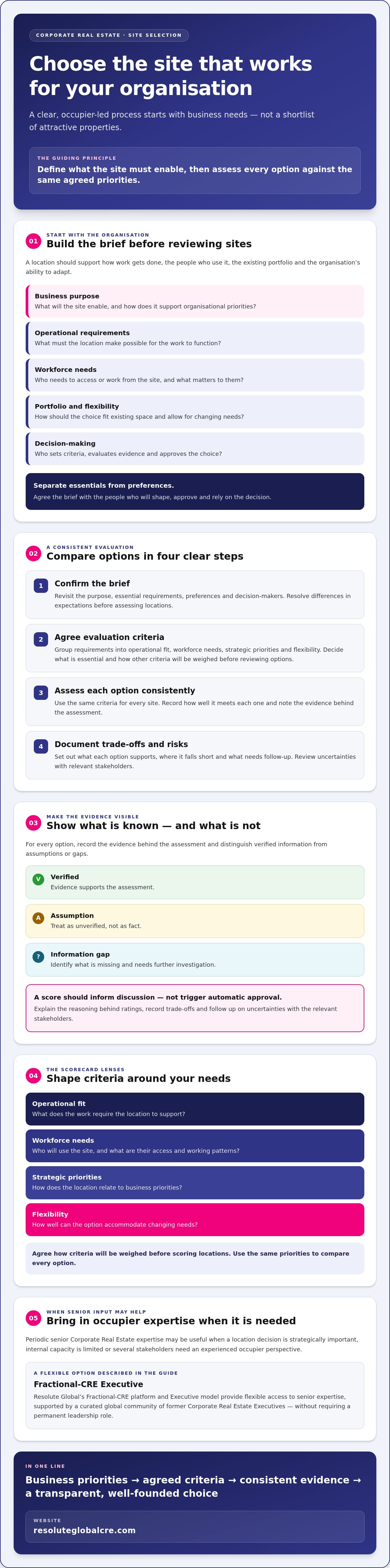
Before reviewing options, agree the brief with the people who will shape, approve and rely on the decision. Distinguish essential requirements from preferences, and make sure each criterion relates to the site’s purpose.
Business purpose
What will this site enable, and how does it support organisational priorities?
Operational requirements
What must the location make possible for the work to function?
Workforce needs
Who needs to access or work from the site, and what matters to them?
Portfolio and flexibility
How should the decision fit existing space and allow for changing needs?
Decision-making
Who sets the criteria, evaluates the evidence and approves the choice?
Occupier-led selection starts with business needs, not listings. With that principle established, comparisons can focus on how well each option serves the organisation, not simply how attractive it appears.
How to evaluate site options with a clear occupier-led process
A consistent process helps stakeholders compare like with like and spot incomplete evidence. Use the same agreed brief and criteria for every option. This makes it easier to see whether a difference in score reflects a genuine advantage or simply a change in assumptions.
Confirm the brief.
Revisit the purpose, essential requirements, preferences and decision-makers. Resolve differences in expectations before assessing locations.
Agree evaluation criteria.
Group requirements into operational fit, workforce needs, strategic priorities and flexibility. Decide which criteria are essential and how to weigh the others before reviewing options.
Assess each option consistently.
Record how well each site meets each criterion and note the evidence behind the assessment. Mark what’s verified, what’s an assumption and what information is missing.
Document trade-offs and risks.
Set out what each option supports, where it falls short and what needs follow-up. Review uncertainties with the relevant stakeholders, without treating unverified points as fact.
What criteria belong in a site-selection scorecard?
Build the scorecard around your organisation’s needs, not a universal checklist. For operational fit, record what the work requires the location to support. For workforce needs, consider who will use the site and their access and working patterns. Link strategic criteria to business priorities, and use flexibility to assess how well an option can accommodate changing needs. Agree how to weigh the criteria before scoring locations.
Agreed criteria make comparisons more transparent because every option is judged against the same priorities. A score should inform discussion, not trigger automatic approval. Explain the reasoning behind ratings and list gaps that need further investigation. For conflict-free, occupier-focused Corporate Real Estate guidance, explore Resolute Global’s Corporate Real Estate guidance.
When site selection advisory services need senior occupier expertise
A site decision can place substantial demands on Corporate Real Estate leadership, even when an organisation doesn’t need a permanent executive in that role. Periodic senior expertise may be useful when a location decision is strategically important, internal capacity is limited or several stakeholders need an experienced occupier perspective. The assignment may be focused, but the judgement required is not.
Site selection advisory services can form part of broader occupier-focused Corporate Real Estate guidance. Resolute Global’s Fractional-CRE platform and Fractional-CRE Executive model give organisations flexible access to senior expertise, supported by a curated global community of former Corporate Real Estate Executives. This can suit businesses that need experienced input without making a permanent executive appointment.
How can flexible CRE leadership support a site decision?
A Fractional Executive is an embedded leader with defined authority, not an arm’s-length adviser or task-based contractor. The executive can work within the organisation’s decision-making structure and bring senior Corporate Real Estate perspective to the requirements, evaluation and trade-offs. Agree the scope of authority so stakeholders know who is guiding the work and how decisions will be made.
Resolute Global can engage Fractional Executives in a matter of hours, with engagements completed in two hours. This offers a flexible way to access senior expertise when the organisation needs it, without establishing a permanent leadership role.
To discuss the level of expertise your site decision requires, contact Resolute Global at www.ResoluteGlobalCRE.com, james.mclean@resoluteglobalcre.com or +44 7867 140785.
Make your next site decision work for the business
Strong site decisions begin with business purpose, then test each option against agreed criteria and documented evidence. This keeps priorities visible, trade-offs clear and the rationale transparent.
Effective site selection advisory services should serve the occupier’s operational needs, workforce, portfolio priorities and future flexibility, rather than letting available properties shape the brief. Where a pivotal decision needs senior Corporate Real Estate expertise but not a permanent executive, flexible leadership can add capacity and clear accountability.
More than 72% of Fractional Executives have 15+ years of experience. Resolute Global’s model offers flexible access to this senior expertise, with engagements that can begin in a matter of hours, including engagements completed in two hours.
A clear mandate can turn a complex site choice into a confident, evidence-led decision. Discuss your Corporate Real Estate requirements with Resolute Global, or contact james.mclean@resoluteglobalcre.com or +44 7867 140785.
Frequently Asked Questions
What do site selection advisory services include?
Site selection advisory services help occupiers translate business requirements into a site brief, establish evaluation criteria, compare options and clarify trade-offs. The precise scope depends on the organisation’s needs and the expertise required. This support can help structure a decision, but don’t assume it includes transaction, legal or property-management services. Confirm the agreed scope before work begins.
How do you choose a site for a business?
Start by defining the business purpose and operational requirements the site must support. Agree essential criteria with relevant stakeholders, then compare options consistently against those priorities. Check the evidence behind each judgement, record assumptions separately and list unresolved questions for follow-up. There’s no universal checklist or single best location: the right choice depends on what your organisation needs the site to achieve.
When should a business use a site selection adviser?
Consider senior Corporate Real Estate expertise when internal capability is limited, requirements are changing or decision-makers need help aligning priorities. An experienced occupier perspective may help bring structure to a complex choice, but not every organisation needs external support. Consider the decision’s importance, the expertise available internally and whether flexible support would address a specific gap.
Can a business access senior Corporate Real Estate expertise without a full-time hire?
Yes. Resolute Global’s Fractional-CRE Executive model provides flexible access to embedded senior leadership with defined authority, without requiring a permanent executive hire. Fractional Executives can be engaged in a matter of hours, with engagements completed in two hours. This approach may suit organisations that need senior Corporate Real Estate expertise but don’t have an ongoing requirement for a full-time role.
Proudly Untraditional
We’re proudly untraditional in the way we think, operate, and deliver value in the Corporate Real Estate sector.
Whether you’re a client seeking a new experience or an independent real estate adviser please get in touch to learn more.
More from the field
Keep reading for more sharp analysis on global corporate real estate


