
Industrial Tenant Representation: Guide for Occupiers
What if the biggest risk in an industrial property decision is starting the search before defining what the operation needs? Industrial tenant representation puts the occupier’s business case first, aligning property choices with requirements such as workflow, capacity, location and future growth. A...


What if the biggest risk in an industrial property decision is starting the search before defining what the operation needs? Industrial tenant representation puts the occupier’s business case first, aligning property choices with requirements such as workflow, capacity, location and future growth.
A complex search, negotiation and lease process can consume senior leaders’ time. A property decision shaped around availability alone may also overlook wider business priorities. Independent, occupier-focused guidance helps keep those interests at the centre.
This guide explains how to assess industrial property options against operational needs, how conflict-free representation can strengthen decision-making, and how flexible Corporate Real Estate expertise can provide experienced leadership without a permanent senior hire. You’ll also learn how Fractional-CRE can bring embedded expertise with defined authority, scaled to your organisation’s needs. Better decisions start with the occupier.
Key Takeaways
• Use industrial tenant representation to keep property decisions focused on occupier priorities, not simply the space available.
• Define operational needs first, then set property criteria and assess each option against the organisation’s wider strategy.
• Consider how current and anticipated operations, portfolio context and decision priorities shape the right site requirements.
• Use conflict-free guidance and Fractional-CRE leadership to access experienced, embedded expertise that can flex with your needs.
Why industrial tenant representation should start with occupier priorities
Industrial tenant representation is guidance that puts an occupier’s property and business interests first when assessing, selecting or negotiating industrial space. It starts not with a list of available buildings, but with a clear understanding of what the organisation needs its property to enable.
A facility is part of how a business operates, not simply a place to occupy. A warehouse, distribution facility or manufacturing site may each serve a different purpose, so no single property type suits every organisation. Start with the work the facility must support. Then consider how its location and function fit the organisation’s priorities. Without a clear brief, an available option can end up defining the requirement by default.
Which industrial property decisions call for occupier-focused advice?
Occupier-focused advice is useful whenever a property choice could affect operational plans or wider business goals. A distribution operation, for example, may need to assess how a facility’s location supports its network. A manufacturer may focus on how a site serves its production plans. In either case, assess the property against the organisation’s intended use rather than assuming another occupier’s requirements will apply.
Strategic Corporate Real Estate guidance looks beyond the immediate transaction. It connects property decisions to business priorities and the organisation’s wider property needs. Transaction-focused support, by contrast, concentrates on a particular search or deal. Both can matter, but the transaction should not define the strategy. Clarifying the business case first gives decision-makers a stronger basis for setting criteria, comparing options and weighing trade-offs.
Resolute Global provides occupier-focused Corporate Real Estate guidance, with conflict-free advice for tenants and occupiers. The focus is on helping leaders make property decisions that serve their business, not advancing a landlord’s interests or steering an organisation towards a property simply because it is available. Start with the operation, then assess the property.
How to assess industrial property needs before choosing a site
A clear assessment turns broad business ambitions into criteria leaders can use to compare industrial property options. Work through these steps before focusing on individual sites. Keeping operational requirements, preferences and strategic judgement distinct makes the comparison more useful.
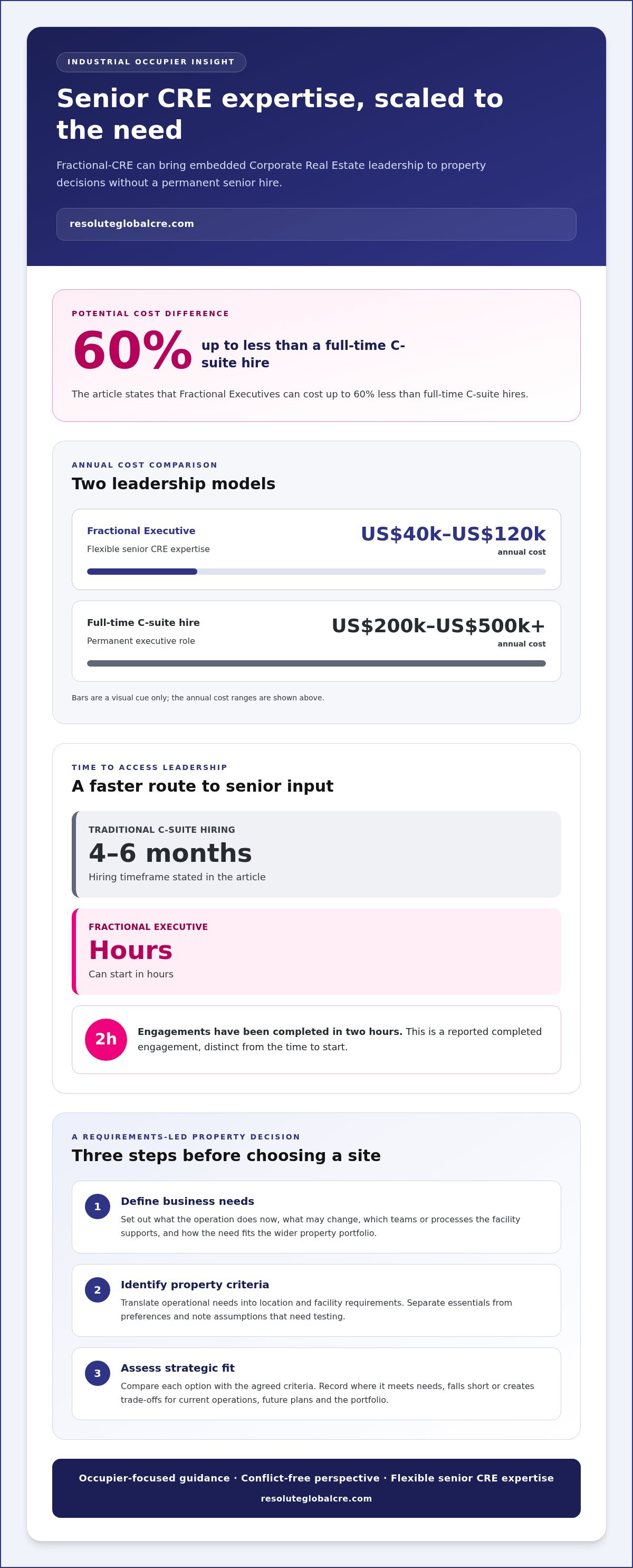
Define business needs.
Describe what the operation does now and what it may need to do in future. Set out the facility’s role, the teams or processes it must support, anticipated changes and how the requirement fits the wider property portfolio. Agree which business priorities the property decision must serve.
Identify property criteria.
Translate those needs into requirements for location and facility function. Separate essentials from preferences, and record assumptions that need testing. For example, a preferred location may be negotiable if another option supports the operation and wider priorities more effectively.
Assess strategic fit.
Compare each option against the agreed criteria. Note where it meets a need, falls short or creates a trade-off. Consider the implications for current operations, anticipated plans and the organisation’s portfolio rather than treating the site as an isolated transaction.
What should an occupier define before assessing industrial property?
Bring operational knowledge to the brief: what the facility must support, what may change and which priorities matter most. Senior Corporate Real Estate judgement can help frame the requirements, interpret trade-offs and connect the property decision to portfolio strategy. Unbiased guidance keeps the comparison centred on the occupier’s criteria rather than steering leaders towards a particular option. That gives decision-makers a clearer basis for explaining and assessing their choice.
Resolute Global’s occupier-focused CRE guidance helps leaders shape a requirements-led assessment, with advice centred on the organisation’s interests.
How conflict-free industrial tenant representation can scale with your needs
Industrial tenant representation can protect occupier interests while giving leaders access to senior Corporate Real Estate expertise without a permanent executive hire. Resolute Global’s Fractional-CRE platform connects organisations with a curated global community of former Corporate Real Estate Executives. Their experience brings an occupier-only perspective to property decisions.
The model is designed to be flexible. Fractional Executives can cost up to 60 % less than full-time C-suite hires. The annual cost comparison is US$40k-US$120k for a Fractional Executive versus US$200k-US$500k+ for a full-time C-suite hire. Traditional C-suite hiring takes 4-6 months, while Fractional Executives can start in hours. Engagements have been completed in two hours.
When can a Fractional-CRE Executive support an industrial occupier?
This approach can suit mid-market and global organisations that need experienced CRE leadership periodically. For example, a property decision may call for senior judgement even when ongoing full-time leadership is not the right fit. Engagements can scale with the organisation’s needs. A Fractional-CRE Executive is an embedded leader with defined authority, not an arm’s-length adviser or task-based contractor. This connects the role to the organisation’s priorities and decision-making.
For an occupier considering a new industrial site, a lease decision or a wider property requirement, flexible senior input can bring strategic oversight without adding a permanent role. The level of expertise can change as business needs evolve.
Put your next property decision on a stronger footing
Make your property priorities clear before a search or negotiation begins. With industrial tenant representation centred on your organisation, you can approach the decision with independent Corporate Real Estate judgement and a clearer view of what the business needs from its property strategy.
More than 72 % of Fractional Executives have 15+ years of experience. Engagements can begin in hours, and we’ve done it in two hours. For organisations that need senior expertise without a permanent appointment, this model offers leadership that can flex with changing needs.
Discuss your occupier-focused CRE needs with Resolute Global. You can also reach the team at www.ResoluteGlobalCRE.com, james.mclean@resoluteglobalcre.com or +44 7867 140785.
Frequently Asked Questions
Is industrial tenant representation only relevant to large organisations?
No. Industrial property decisions can affect organisations of different sizes, and Resolute Global serves mid-market and global organisations managing Corporate Real Estate portfolios. The practical question is whether the business needs occupier-focused guidance or periodic senior CRE expertise. An organisation reviewing a single facility may need strategic input just as a larger portfolio holder might.
Can industrial tenant representation support a lease renewal as well as a new property search?
Yes. Occupier-focused guidance can help an organisation assess an existing industrial property as well as a new requirement. For a renewal, consider how operational needs have changed, whether the property still serves those needs and how the decision aligns with current business priorities. Renewal should not be assumed to be the right choice.
Does an organisation with an in-house CRE team still benefit from external senior expertise?
Yes. An established team may need additional senior judgement when priorities shift, a capability gap emerges or a complex decision places extra demands on its leaders. A Fractional-CRE Executive can work as a flexible, embedded leader with defined authority, complementing the team’s existing knowledge. This adds capacity or perspective when needed without assuming the organisation must replace its in-house function.
Proudly Untraditional
We’re proudly untraditional in the way we think, operate, and deliver value in the Corporate Real Estate sector.
Whether you’re a client seeking a new experience or an independent real estate adviser please get in touch to learn more.
More from the field
Keep reading for more sharp analysis on global corporate real estate


