
How Do Tenant Rep Brokers Get Paid? A Guide to Conflict-Free Corporate Real Estate Advice
If you aren't paying your real estate advisor directly, you must ask whose interests they're truly protecting. Most occupiers eventually ask how do tenant rep brokers get paid, only to discover a system where the landlord holds the purse strings. It's a legacy structure that prioritises transaction...


If you aren't paying your real estate advisor directly, you must ask whose interests they're truly protecting. Most occupiers eventually ask how do tenant rep brokers get paid, only to discover a system where the landlord holds the purse strings. It's a legacy structure that prioritises transaction volume over strategic alignment. You likely feel the weight of escalating occupancy costs and the frustrating opacity of commission splits. We recognise that securing the right space shouldn't mean compromising on transparency.
This guide clarifies the traditional commission landscape whilst exposing the inherent risks of dual agency that often inflate your long-term liabilities. You'll learn how to bypass these constraints through modern Fractional CRE models. These provide elite, senior-level expertise without the £200,000 price tag of a permanent C-suite hire. We'll explore a more intelligent, conflict-free way to manage your portfolio. It's a model built on independence and surgical precision.
Key Takeaways
• Master the mechanics of how do tenant rep brokers get paid to identify where landlord-funded commissions might be compromising your commercial objectives.
• Recognise the strategic advantages of fee-for-service and Fractional CRE models in delivering transparent, unbundled advice that prioritises the occupier's bottom line.
• Evaluate your current Corporate Real Estate strategy to uncover hidden risks and inefficiencies stemming from traditional, transaction-heavy brokerage relationships.
• Access elite, senior-level expertise through an agile platform that scales with your business needs, offering a cost-effective alternative to permanent C-suite recruitment.
The Traditional Commission Model: How Standard Corporate Real Estate Fees Work
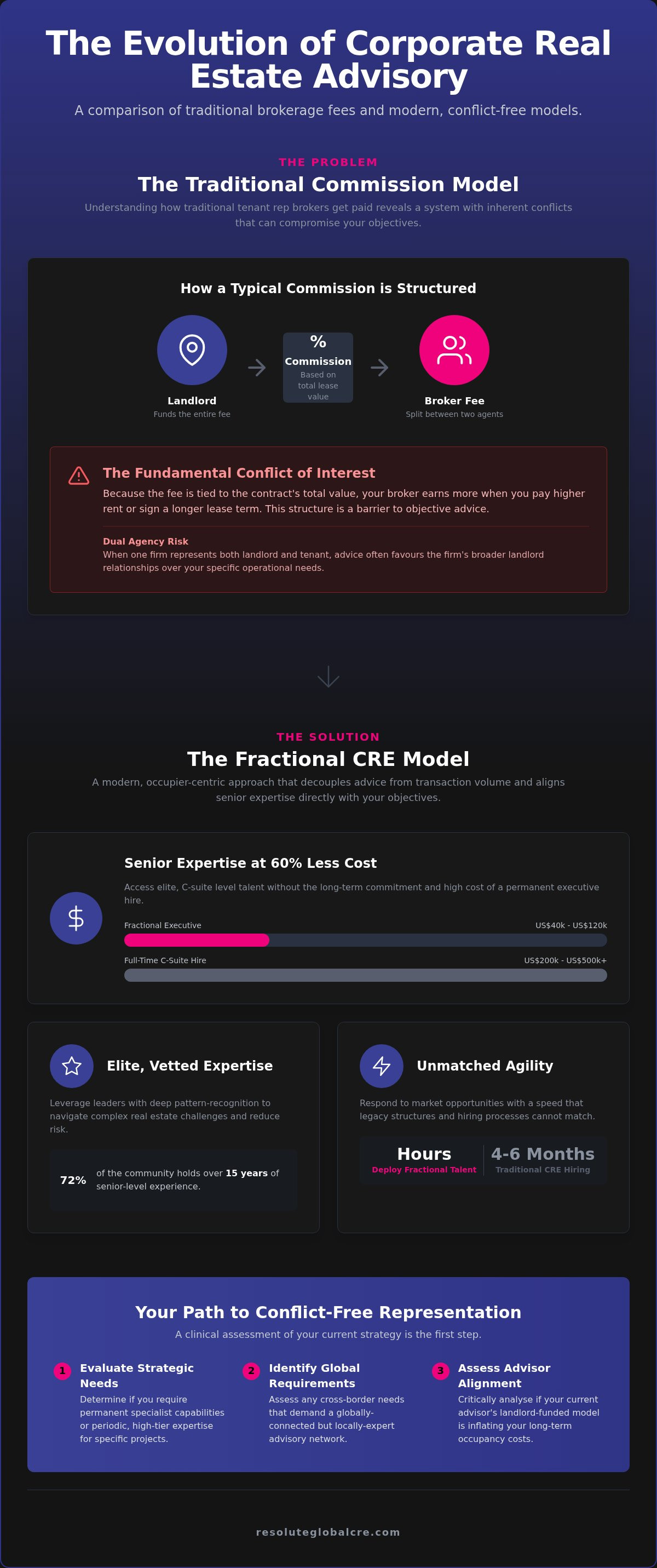
The mechanics of property transactions often obscure the true cost of advice. When asking how do tenant rep brokers get paid, the answer usually points towards the landlord. In a standard arrangement, the building owner pays a commission that is split between their listing agent and your representative. This fee is calculated either as a percentage of the total lease value or a fixed rate per square foot. Typically, the payout is staggered: 50% is issued upon lease execution, whilst the remainder follows once you take possession of the space. It's a system designed for the landlord's convenience.
However, this structure creates a fundamental misalignment. Because the fee is tied to the contract's total value, your broker actually earns more when you pay higher rent or sign a longer term. Much like a Business broker facilitating a sale, the intermediary's reward is tethered to the transaction price. This isn't just a quirk of the industry; it's a structural barrier to objective advice.
The Hidden Conflict: Why Dual Agency Compromises Occupier Interests
The issue intensifies with dual agency, where a single firm represents both the landlord and the tenant within the same market. A conflict of interest arises when an advisor's financial reward increases in direct proportion to the costs they are supposed to be minimising for their client. Understanding how do tenant rep brokers get paid in these scenarios reveals why recommendations often favour the firm's broader landlord relationships over your specific operational needs. For business leaders who prioritise transparency and risk reduction, conflict-free representation is essential. It's about ensuring your advisor's loyalty isn't for sale to the highest bidder.
Modern Compensation Models: From Fee-for-Service to Fractional CRE
The industry is evolving. Sophisticated occupiers are moving away from the opaque commission structures discussed earlier, opting instead for models that prioritise absolute transparency. Fee-for-service arrangements decouple advice from transaction volume, ensuring your representative's goals align perfectly with your fiscal health. Similarly, retainer-based models provide ongoing strategic support, transforming the relationship from a one-off deal into a long-term partnership. These alternatives solve the fundamental problem of how do tenant rep brokers get paid by putting the occupier in control of the fee structure.
Whilst these models offer an improvement, the most significant disruption comes from the world's first platform for Fractional CRE leadership. This isn't merely about paying differently; it's about accessing a higher tier of talent. As noted in Three Ways To Become A Millionaire Using Commercial Real Estate, traditional brokers are often incentivised by the sheer scale of the transaction. Understanding how do tenant rep brokers get paid in the legacy model reveals why this new approach is gaining such rapid traction amongst global firms.
The Fractional CRE Advantage: Senior Expertise at 60% Less Cost
Choosing a Fractional Executive provides immediate access to pattern-recognition from over 15 years of experience, a benchmark held by 72% of our community. Unlike external consultants, these are embedded leaders with defined authority who integrate into your team with surgical precision. This model reduces risk by providing elite talent without the long-term commitment of a permanent hire. Whilst a full-time C-suite executive costs US$200k to US$500k+, a Fractional Executive delivers senior-level expertise for US$40k to US$120k. It's a more intelligent way to operate.
How to Organise Conflict-Free Representation for Your Organisation
Transitioning from the mechanics of how do tenant rep brokers get paid to establishing a conflict-free framework requires a clinical assessment of your current strategy. You must identify specific gaps slowing your growth or increasing your risk profile. Start by evaluating your needs:
• Determine if you require permanent specialist capabilities or periodic, high-tier expertise.
• Identify cross-border requirements that demand a global real estate advisory network.
• Assess whether your current advisor's landlord-alignment is inflating your occupancy costs.
Whilst traditional firms often suggest that hiring a broker takes four to six months, you can now deploy senior-calibre talent in a matter of hours. Engagements can be completed in as little as two hours. This speed allows you to respond to market opportunities with an agility that legacy structures simply cannot match. It's about securing the global reach of a giant with the personal touch of a boutique firm.
Leveraging an Agile Global Advisory Network
An occupier-focused network eliminates the divided loyalties inherent in traditional firms. This independence is vital for managing cross-border requirements with surgical precision. The scalability of Fractional Executives allows you to expand your reach during growth and contract as needs shift. It's a data-driven approach to leadership. Fractional roles have tripled since 2018, reflecting a global shift toward agility and transparency. By prioritising conflict-free Corporate Real Estate solutions, you ensure your advisor's only objective is your advantage.
Securing Your Strategic Advantage
The legacy system of landlord-funded commissions is a structural hurdle to truly independent advice. By understanding how do tenant rep brokers get paid, you've taken the first step toward reclaiming control of your occupancy strategy. You no longer have to settle for the divided loyalties of traditional brokerage or the excessive costs of permanent C-suite recruitment. It's time to transition toward a model that rewards transparency and strategic alignment.
Embracing a Fractional-CRE approach allows you to deploy elite talent with over 15 years of experience in as little as two hours. These embedded leaders deliver surgical precision whilst costing up to 60% less than full-time hires. It's a more intelligent, unencumbered way to manage your global portfolio. You deserve a partner who prioritises your bottom line over their own commission split. Book a Fractional-CRE Executive for your organisation today and transform your real estate into a genuine driver of growth.
Frequently Asked Questions
Is tenant representation really 'free' if the landlord pays?
No, tenant representation is never truly free because the commission is factored into your lease costs. When investigating how do tenant rep brokers get paid, it's clear that landlord-funded fees incentivise higher rents and longer terms. You're effectively paying for your advisor through inflated occupancy costs, which compromises the independence of the advice you receive. True value requires a conflict-free fee structure.
What is the difference between a Fractional CRE Executive and a consultant?
The primary distinction lies in authority and integration. Unlike a consultant who provides external recommendations, a Fractional CRE Executive is an embedded leader within your organisation. They possess the defined authority to execute strategies and take ownership of results. With 72% of our community holding over 15 years of experience, they bring senior-level pattern recognition that goes far beyond traditional project-based consulting.
How quickly can a Fractional Corporate Real Estate leader start?
You can deploy a Fractional Corporate Real Estate leader with surgical speed. Engagements on our platform can be active in as little as two hours, providing an agile alternative to the months-long recruitment cycles of permanent hires. This responsiveness allows your business to capitalise on market shifts immediately, ensuring you have senior-level expertise exactly when a strategic gap or opportunity emerges.
Why is dual agency considered a conflict of interest for tenants?
Dual agency creates a fundamental conflict because a single firm cannot serve two masters with opposing financial goals. When a broker represents both the landlord and the tenant, their loyalty is divided. This structural flaw often leads to biased advice that favours the landlord's revenue over the occupier's savings. Understanding how do tenant rep brokers get paid in these scenarios is vital for risk reduction.
Proudly Untraditional
We’re proudly untraditional in the way we think, operate, and deliver value in the Corporate Real Estate sector.
Whether you’re a client seeking a new experience or an independent real estate adviser please get in touch to learn more.
More from the field
Keep reading for more sharp analysis on global corporate real estate


